

You don’t need to do as much as open LinkedIn, and you’ll get flooded with the latest generative AI possibilities. As companies explore the potential of genAI, it’s crucial to understand where efforts yield the most impactful results. We’ve developed a discovery process that helps uncover the most interesting genAI opportunities, balancing business and user needs with technical viability.
Exploring genAI applications: two pathways
The use of GenAI can typically be divided into two main categories:
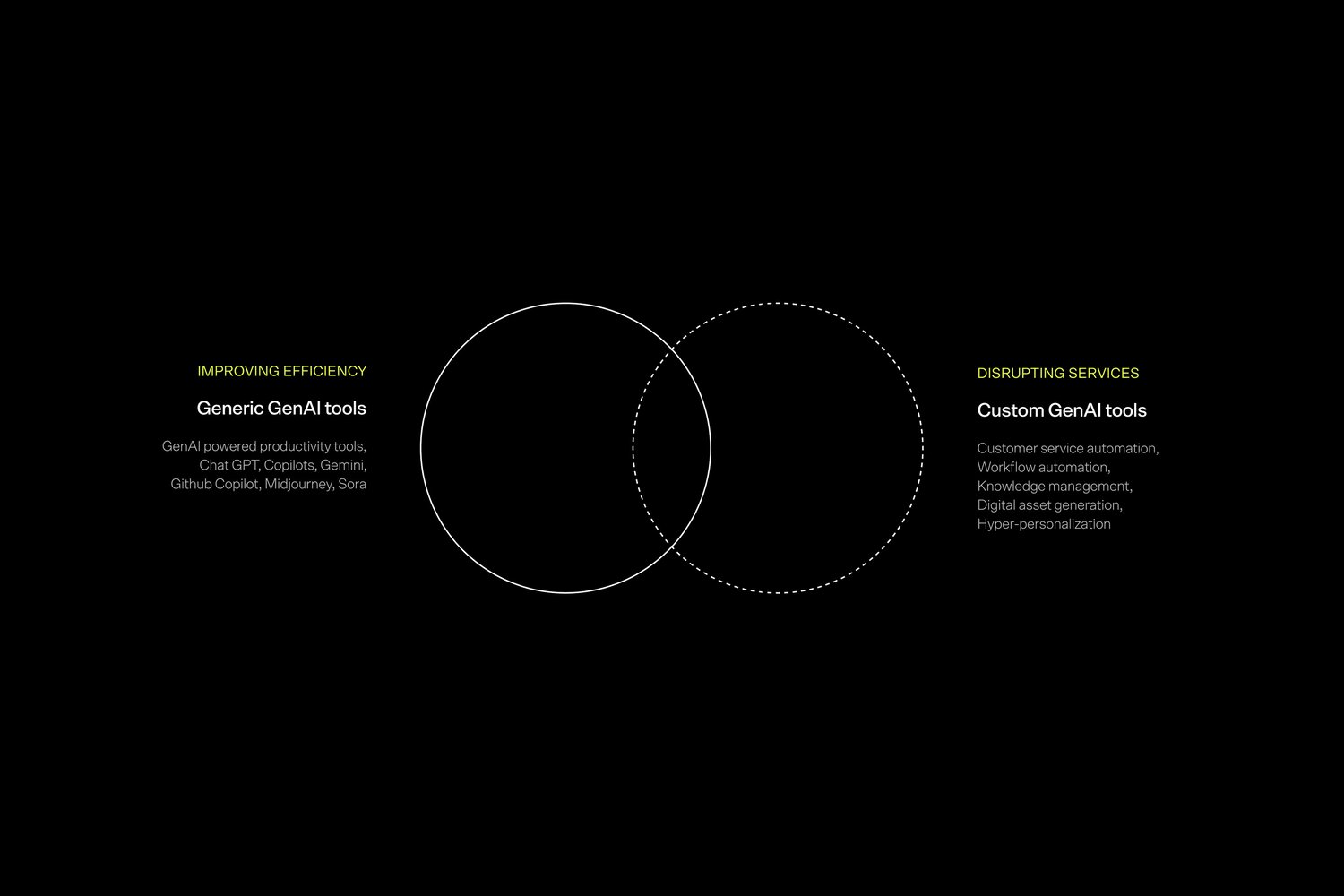
Generic genAI tools
These tools – such as ChatGPT or Microsoft’s Copilot – can improve individual productivity in various professional settings, from writing code to drafting business communications. They are widely available and can address various user needs, but getting the most out of them requires some prompting skills.
Custom genAI tools
These are tailored AI solutions that are developed to address specific business needs. When a larger group of professionals or customers share similar needs, it makes sense to build custom genAI tools. They can enhance and unify internal processes or transform the products and services a company offers. This is where the potential for significant business value often lies, and it’s the focus of our discovery process.
As an example of dedicated tools, in our project with ABB, we identified that a large group of sales professionals have similar needs for analyzing and processing RFPs. We identified an opportunity to improve the sales process with genAI. By building a dedicated genAI tool, we could meet their needs with a cost-effective solution that has a real business impact.
Our genAI discovery process
The journey to discovering where genAI has the most impact involves a structured yet creative process. Here’s how we approach it.
Before we start, we usually focus the search on a selected set of business processes that could benefit from genAI. For example, we may decide to concentrate on internal sales or customer service operations. By focusing on specific areas, we create a manageable scope for exploration.
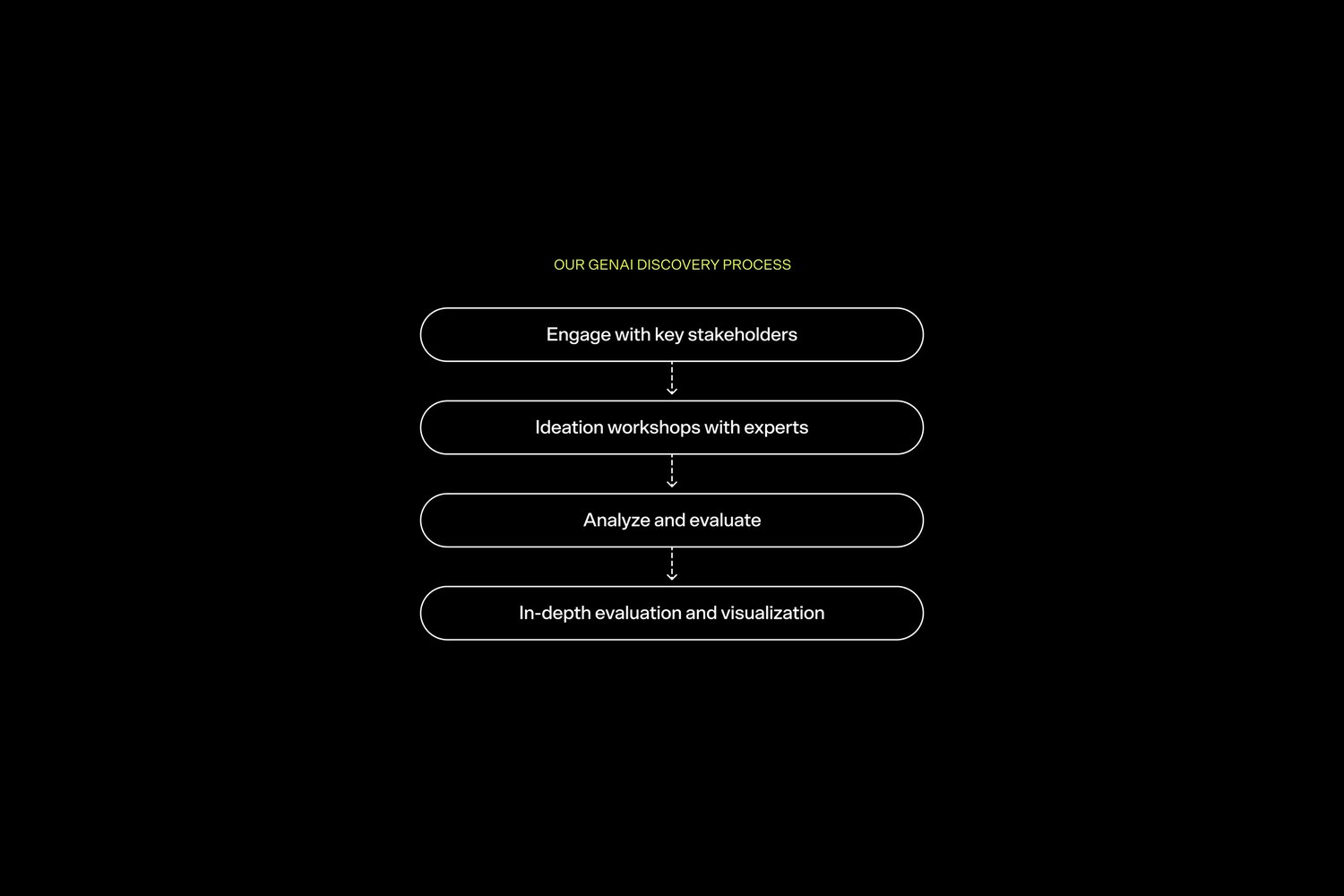
1. Engage with key stakeholders
We begin by interviewing key stakeholders, especially those directly involved in the day-to-day work. These conversations help us uncover pain points, bottlenecks, and areas where improvements are not only possible but also necessary.
As we gather information, we look for places where genAI could make a big difference. It’s important to capture all improvement ideas during this stage, but our goal is to highlight the ones that offer the most transformative potential.
2. Ideation workshops with experts
Once we’ve collected initial insights, we bring together experts and business owners for ideation workshops. The ideation will be informed by the findings in the user and stakeholder interviews and by an overview of the data and information that the company potentially has for the genAI to process.
These sessions help us refine and expand on the ideas gathered from interviews. Collaboration is key here, as it ensures we get diverse perspectives and deeper insights.
3. Analyze and evaluate
After gathering ideas, we analyze them based on several criteria.
- Expected business impact and reach
- Potential improvement to employee or customer experience
- Availability of data and the maturity of the data platforms
- Technical feasibility and cost of implementation
- Alignment with the company’s broader strategy
With the interview analysis, in the workshops, we generate a long list of potential genAI applications. To make the process more manageable, we conduct a preliminary round of filtering to narrow down the ideas to those with the highest potential. Even ideas that don’t make the shortlist are saved for future consideration.
4. In-depth evaluation and visualization
The shortlisted ideas undergo further scrutiny. We examine them against our set criteria and often use visualization tools to ensure that all stakeholders have a clear and aligned understanding of the proposed solutions. We summarize the findings in a standard template that we call Concept cards. The template has been proven to be very useful in ensuring that we have a common understanding of each idea and can compare them fairly.
Finally, we rank the top ideas using an effort/impact matrix. This tool helps us map out which projects offer the highest value relative to the effort required to implement them. This final ranking informs decisions on which projects to move forward within proof-of-concept stages.

The outcome: genAI as a catalyst for business growth
By taking this balanced approach to discover genAI opportunities, companies can unlock significant value. Whether improving internal processes or transforming customer offerings, the right custom genAI applications can be game-changing.
As the field of genAI technologies advances with unprecedented speed, it is a good idea to periodically review the results of the discovery process and complement it with new insights. It is likely that you will find ideas that were not feasible earlier, but with the latest technology, they provide a viable business model.
This discovery process is not just about incremental improvements. When approached thoughtfully, genAI can help companies reinvent themselves, find new revenue streams, and even disrupt entire industries. The key is to start with a clear focus and collaborate closely with those who know the business inside and out. By doing so, companies can harness the true transformative power of generative AI.