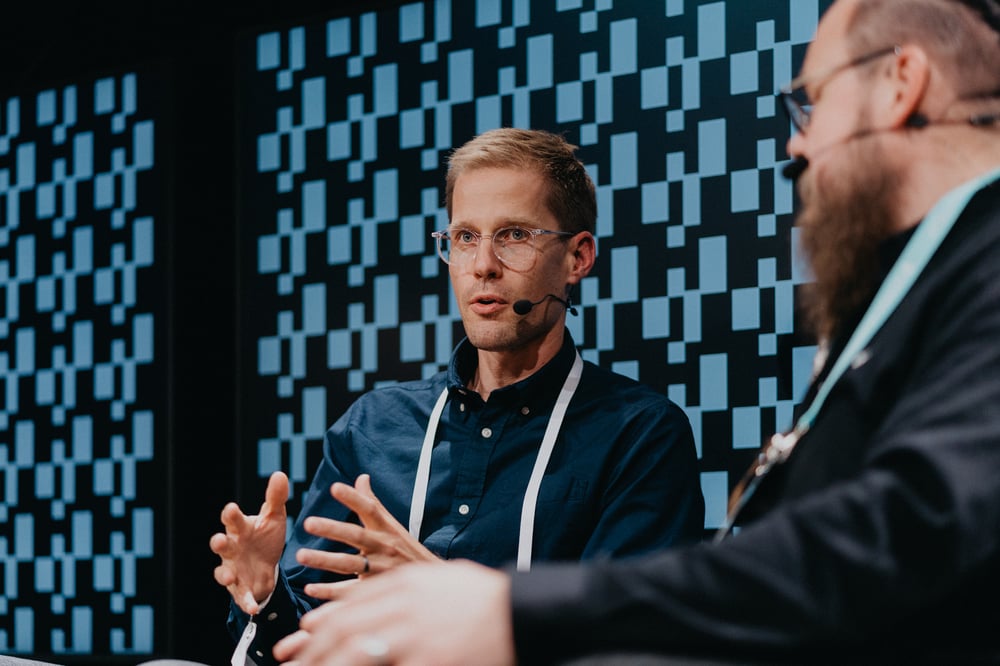
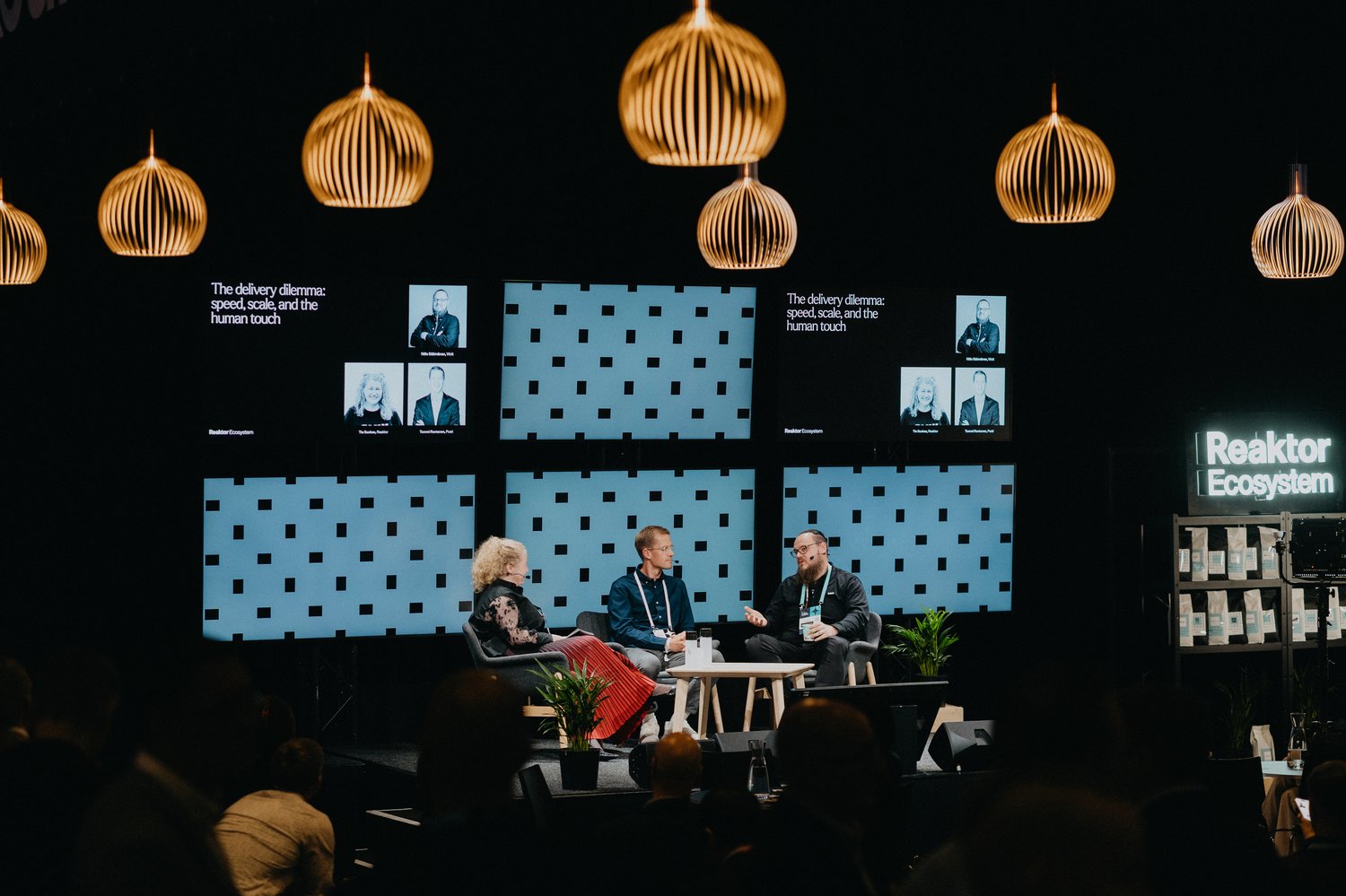
At Nordic Business Forum’s Reaktor Ecosystem Café, we brought together two leaders shaping the future of delivery: Niilo Säämänen, CTO of Wolt, and Tommi Rantanen, VP of Technology at Posti. Despite one company being in the business for a decade and the other for centuries, both leaders emphasized the same point: the heart of great digital experiences is human-centricity.
Delivery has become the invisible infrastructure of everyday life – whether it’s hot dumplings in 20 minutes or a birthday parcel crossing the country. Behind that convenience sits a complex mesh of people, processes, and what both speakers affectionately called “hardcore math.” This conversation with Wolt and Posti digs into how two very different organizations keep the customer at the center while scaling speed and reliability.
Human-centric means ease – inside and out
For both Posti and Wolt, “human-centric” translates to being genuinely easy to work with. Rantanen framed the most inhuman experience as the feeling of being stuck and unable to influence an outcome; his remedy is to design channels and services that remove friction for customers while also removing friction inside the company. That is why Posti builds roadmaps with business and technology at the same table from the start, collapsing the old hand-offs that slow teams down. Säämänen echoed the sentiment from Wolt’s hyper-local vantage point: whether you serve one city or thirty-five countries, the job is still to win the hearts and minds of every courier, merchant, and consumer in each neighborhood.
Edge cases matter more than averages
Säämänen cautioned against falling in love with headline KPIs. A 97% “perfect delivery” rate can hide a 0.5% pocket of two-hour disasters that quietly create churn. Feelings, he said, are decent inputs; outcomes need data. The fix is to zoom into specific journeys, find the worst moments, and design graceful recovery: refunds, make-goods, and earnest support that can convert detractors into advocates. Rantanen agreed and offered a personal story of Wolt turning a poor experience into loyalty through fast, thoughtful remediation – proof that the floor you raise often matters more than the ceiling you celebrate.
Hardcore math under the hood of great logistics
Both leaders affectionately call the quantitative backbone of their work “hardcore math.” Logistics networks are complex to model and optimize, and in low-margin, time-sensitive businesses, rigor beats rhetoric. The pattern is consistent: establish a trustworthy data foundation, then layer sophisticated optimization that balances speed, cost, and reliability. It’s not about glossy edge features so much as the operational mesh, routing, batching, placement, and capacity that quietly determine whether the human experience feels effortless.
From more lockers to the right lockers
Posti illustrated what customer-led infrastructure actually looks like. Rather than chasing raw counts of parcel lockers, the team began forecasting micro-locations customers would truly prefer. A spot that looks ideal on a map can be a dud in real life if it requires paid parking or awkward access. By modeling behavior and context, Posti placed lockers that ramped faster and signaled higher satisfaction. The lesson is simple: model the world as customers live it, not as diagrams draw it.
Learning by doing beats dashboards
Tacit knowledge rarely travels through spreadsheets. Wolt’s courier-experience engineers routinely deliver orders themselves to absorb the constraints, workarounds, and tiny frictions impossible to infer from metrics. Posti draws warehouse and sorting-center experts into technology teams to encode years of implicit know-how into systems that actually fit the floor. Both practices reinforce the same truth: you design better when you’ve felt the job in your bones.

The road ahead: mixed fleets and regional replication
Looking forward, Wolt sees selection – not just city-level breadth but hyperlocal depth – as the real growth lever. To make that economically viable, Säämänen argues for blending human and robotic fleets: sidewalk bots, bike-lane and middle-mile robots, and even drones where regulation allows. The point isn’t replacing couriers; it’s extending reach and speed so a hot coffee five kilometers away can still arrive hot. Posti’s horizon is geographic: take Finland’s next-day performance and replicate it across the Nordics and Baltics, proving that speed at scale is portable when the data, processes, and people are aligned.
The shared playbook
Strip away the differences in age and footprint, and the playbook converges. Keep people at the center by designing for ease. Treat averages with suspicion and over-invest in recovery for the worst moments. Anchor decisions in data and hardcore math, but gather the field truths only real-world practice reveals. Then scale with intention, whether that means a smarter locker on the right corner or a mixed fleet that brings the city closer to every doorstep.