

If you’ve ever felt both excited and overwhelmed by the promises of AI, you’re not alone. Every week, headlines boast of breakthroughs, yet behind the scenes, many industrial companies struggle to translate hype into impact.
Executives hear bold claims that AI will streamline every process, cut costs, and unlock entirely new business models. The reality is more complex than that. AI offers transformative potential, but technology alone rarely creates value. Success depends on execution: selecting the right business problems, building on solid foundations, and sustainably driving adoption.
Here at Reaktor, I’ve seen that any serious industrial AI initiative must start with impact, not hype. That means resisting the lure of market buzz and grounding efforts in the organization’s own realities and strengths. I’ve witnessed how organizations that win focus on solving tangible business problems, rather than just chasing technology.
What really works (and what doesn’t) with AI in the industrial setting
Success doesn’t come from chasing the latest models or running isolated pilots. It comes from solving the right problems, laying a strong foundation, and integrating AI into the daily operations of complex organizations. Here are five core lessons from our client projects on how to approach AI in industrial.
1. Start with the right business problems
Most industrial organizations face no shortage of inefficiencies. Equipment downtime, yield variation, energy waste, and supply chain disruptions all reduce performance. The real challenge lies in prioritization: identifying which problems, once solved, will deliver the greatest impact. More importantly, organizations must determine which challenges they can realistically solve with the data, technology, expertise, and architecture already in place.
Prioritization starts by engaging directly with customers, operational leaders, and frontline teams to uncover pain points and opportunities for improvement. Effective prioritization requires two steps:
- Check feasibility: Organizations identify which problems can be realistically addressed with the existing data, technology, expertise, and architecture.
- Rank by impact vs. effort: Organizations should prioritize initiatives based on their expected business value compared to cost and complexity. This involves examining measurable outcomes, such as reduced downtime, energy savings, or improved throughput, and weighing these against the necessary resources and risks.
From there, a cross-functional steering group or portfolio governance team can evaluate potential use cases, applying consistent criteria such as cost-effectiveness, speed-to-impact, scalability, and risk. The responsibility for this ranking should not rest solely with technologists. It requires a collaborative effort among business leaders, operational managers, and technical experts. Business leaders establish strategic objectives and define value metrics, while operational managers ensure that discussions are rooted in practical feasibility. Technical experts, in turn, verify what the data and infrastructure can actually support.
The aim is to target initiatives that deliver the highest measurable value for the resources invested. This approach frequently reveals opportunities that do not require AI, while also establishing a structured framework for evaluating AI projects. Consequently, AI initiatives start with a clear business case, a responsible owner, and a realistic execution plan, rather than as vague experiments seeking relevance.

Case story: Business-driven approach to AI in the process industry
We partnered with a process industry company that aimed to accelerate its growth ambitions through AI. The leadership team had drafted an ambitious list of AI-driven projects they wanted to pursue.
Early in the engagement, we showed the value of a more systematic approach. Instead of treating AI as the default answer, we focused on covering the root causes of business challenges. Together, we reframed the work around core business objectives, end users, and customers – moving the conversation beyond available technologies.
By applying this human- and business-centered perspective, we co-created a prioritized development roadmap that identified initiatives with the greatest potential impact. Only a small fraction of the original AI ideas emerged as the top ones. At the same time, many high-value opportunities turned out to require more traditional digital development, data solutions, or even adjustments to business processes rather than advanced AI.
2. Scale from day one (but avoid scattered pilots)
Finding a strong AI use case is only the first step; the harder part is scaling it beyond a single success.
Too often, companies fall into the “pilot trap”, which means running small experiments that deliver results in one part of the business but never scale across the organization. The outcome is a patchwork of disconnected solutions, duplicated infrastructure, and lessons that fail to spread.

To avoid this trap, organizations must plan for scale from the very beginning. This means, for example, shared platforms, unified data architectures, and consistent governance enable every project to strengthen the organization’s overall capability. Then each pilot should serve as a building block in a long-term transformation roadmap, not just as an isolated exercise.
Case story: ABB and proactive scalability in practice
In our work with the global technology company ABB, we developed AI-assisted sales tools that illustrate proactive scalability. Through feasibility studies and pilot experiments, we validated the solution on a small scale – successfully climbing the “first mountain”.
Even during this early phase, the team mapped out the path to higher peaks. We explored what capabilities and solutions would be required to extend the impact, whether into new business divisions, geographical regions, user groups, or entirely new functionalities.
By embedding scalability into the design from the start, we ensured the solution could evolve in step with ABB’s broader growth ambitions.
3. Architecture and data quality matter more than ever
Scaling AI effectively requires more than strong processes – it demands solid infrastructure. While a quick proof of concept can run on ad-hoc data pipelines, building a sustainable competitive advantage calls for a robust, well-designed architecture.
Modern AI in business typically operates on a centralized, organized data platform that consolidates all company information and ensures its reliability. API-first design principles facilitate the integration of AI into daily tasks, while automated machine learning operations (MLOps) handle training, deployment, and monitoring. By incorporating security and compliance from the start, the system operates consistently even in highly regulated environments. What comes to regulatory compliance, such as alignment with the EU AI Act, should be treated not as a burden but as an opportunity to stand out.
Together, these components cut cycle times from months to weeks, enabling faster iteration and improvement.

Equally important is the company’s broader enterprise architecture. In many industrial organizations, mature systems already capture and organize the operational and transactional data that AI depends on. When integrated and consistently used, these core systems provide a strong foundation: the data is structured, centralized, and accessible, which greatly reduces preparation time.
Enterprise systems often incorporate workflow automation, which allows AI insights to directly influence daily operations, effectively closing the loop from prediction to action.
Poorly organized documentation is one of these situations where organizations should prioritize core systems and architecture rather than prioritizing AI initiatives. If documentation is scattered across multiple unstructured locations, using AI to compile it is rarely the best first step. A more effective approach begins with establishing a robust document management system and governance processes. Once the information is organized and accessible, AI can enhance search, automate classification, and extract insights – delivering better results with far less effort.
Organizations with strong enterprise architecture move quickly to value creation, while those lacking it often spend most of their AI budgets just preparing the groundwork.
Case story: Importance of architectural groundwork
One of our industrial data projects highlighted the critical importance of strong architectural groundwork. The initiative focused on improving the spare parts sales process to increase both efficiency and revenue.
Within weeks, we validated the solution’s potential with a small dataset and user group. Yet IT workshops soon revealed a different reality: the foundations had not been properly laid or adequately designed. To mitigate the risk of a standalone proof of concept, we suggested integrating the solution into the client’s larger system ecosystem. This shift added several months and required multiple architectural discussions, but it ultimately enabled deployment on solid new foundations.
Beyond the technical outcome, the client valued the patience, persistence, and architectural guidance we brought. Our recommendations now serve as a blueprint for preventing similar pitfalls in future initiatives.
Data quality as a cornerstone
Even the most advanced architecture cannot overcome poor or missing data. Without enough data, teams cannot develop models at all. And when data exists but remains fragmented, inconsistent, or collected with uneven standards across sites and systems, AI models built on it generate unreliable and misleading results.
Organizations must establish data practices to ensure data is available and of high quality. Effective governance, automated validation pipelines, and clear ownership of data assets make AI insights trustworthy and actionable. Accuracy, completeness, consistency, and timeliness all matter.
Companies that prioritize data quality and availability reduce costly errors and accelerate time-to-value for their AI initiatives.
Case story: Changing a light for 6 hours
An industrial company set out to develop new maintenance service products for its customers. To support pricing, they turned to historical records of time spent on spare-part replacements and installations. For years, technicians had been asked to log this data into the system, and at first glance, the dataset looked extensive.
A user study at the service sites, however, revealed an unexpected pattern: some technicians had gotten into the habit of logging all maintenance work for a machine under a single item code, with only the total time recorded.
I still vividly recall one case: during the same maintenance visit, a technician replaced a front light, changed the filters, and overhauled the shaft – yet in the time-tracking system, the entry simply read “Lamp replacement – 6 hours.”
4. Blueprint for sustainable adoption in the organization
Infrastructure and governance lay the foundation, but the way people organize around AI determines how quickly and effectively it scales across the business.
A common approach is the ‘hub-and-spoke’ model: a central AI team manages platforms, sets standards, and ensures compliance, while business units identify problems and drive implementation. Striking the right balance between central oversight and local ownership is critical. The central team safeguards quality and prevents fragmentation, while business units ensure AI stays grounded in operational reality.
Even the most well-designed AI program can fail when it encounters cultural resistance. Adoption succeeds only when employees understand and trust the systems that affect their work. Leaders must communicate clearly, realistically, and consistently. They must also provide targeted training so employees view AI as a tool to use, rather than a threat to fear.

Case story: Centralized AI offices – pitfalls and takeaways
In one industrial client project, we encountered an operating model where a centralized AI office drove development and acted as the gatekeeper for all AI initiatives. Although well-intentioned, this setup created two major challenges: 1) bottlenecks in execution, and 2) overemphasis on technology.
1) Bottlenecks in execution: The centralized office became overloaded with competing projects, slowing its ability to support business units effectively. Deliverables from the development pipeline lost impact, and in some cases, progress stalled entirely. Frustrated, business units began bypassing the agreed framework to push initiatives forward on their own.
2) Overemphasis on technology: The centralized team focused too heavily on technical aspects and grew disconnected from business needs. It overlooked that effective solutions rarely rely on AI alone – they typically combine data, digital development, human expertise, process improvements, and organizational adoption.
Lesson learned: This case emphasized the need to strike a balance between technical excellence and strong alignment with business goals.
5. AI is a tool among many
With solid infrastructure and strong data practices in place, AI should not be treated as fundamentally different from other technologies. Whether teams solve a problem with AI or traditional software development, the underlying processes and methods stay the same.
The key is to treat AI as one tool among many – choosing and applying it with the same discipline used for any other technology. Successful technology delivery follows the same five principles:
- define the problem clearly
- develop iteratively
- test thoroughly
- deploy effectively
- keep improving
These steps apply to AI models and conventional software solutions.
Treating AI as ‘special’ often adds needless complexity and sets projects up for failure. The most effective approach is to apply the same governance, quality standards, and delivery processes used for other technology initiatives. This consistency accelerates adoption and ensures AI solutions integrate smoothly into business operations.
At the same time, AI’s rapid evolution now allows companies to tackle problems that were once too complex, costly, or impractical to solve. In many situations, experimenting with AI proves faster and more cost-effective than traditional methods – when applied to the right use cases. For example, speech recognition and language translation once required expensive, labor-intensive processes. Still, they can now be achieved in a fraction of the time, opening up new opportunities for efficiency and scale.
Case story: Unlocking value from unstructured information
In a client project, we helped to turn a highly diverse set of documents into structured, usable information with minimal effort. The files included scanned pages, handwritten updates, numerous duplicates, and content in multiple languages and formats. Using traditional methods, cleaning and organizing this information would have required far more time, and likely would not have been commercially viable.
AI changed the equation. By applying modern techniques, we quickly extracted and organized the data, giving the client a reliable foundation for analysis and decision-making.
The last word, the first step
The value of AI doesn’t come from chasing the latest language models or automating for automation’s sake. Its real strength lies in disciplined execution: starting with the right problems, designing for scale, building on solid infrastructure, and embedding AI into both technology and culture.
Transparency is a powerful enabler. When stakeholders understand how AI systems reach their conclusions, they are more likely to trust and use them. As AI’s role increases in industrial sectors, the stakes grow higher. Unchecked biases, cybersecurity gaps, and regulatory non-compliance can quickly erode both performance and trust. Organizations must address these risks early and proactively.
Companies that follow this path see AI less as a headline-grabbing novelty and more as a dependable engine for efficiency, resilience, and competitiveness. The most successful companies combine ambition with the pragmatism needed to turn potential into lasting business impact.
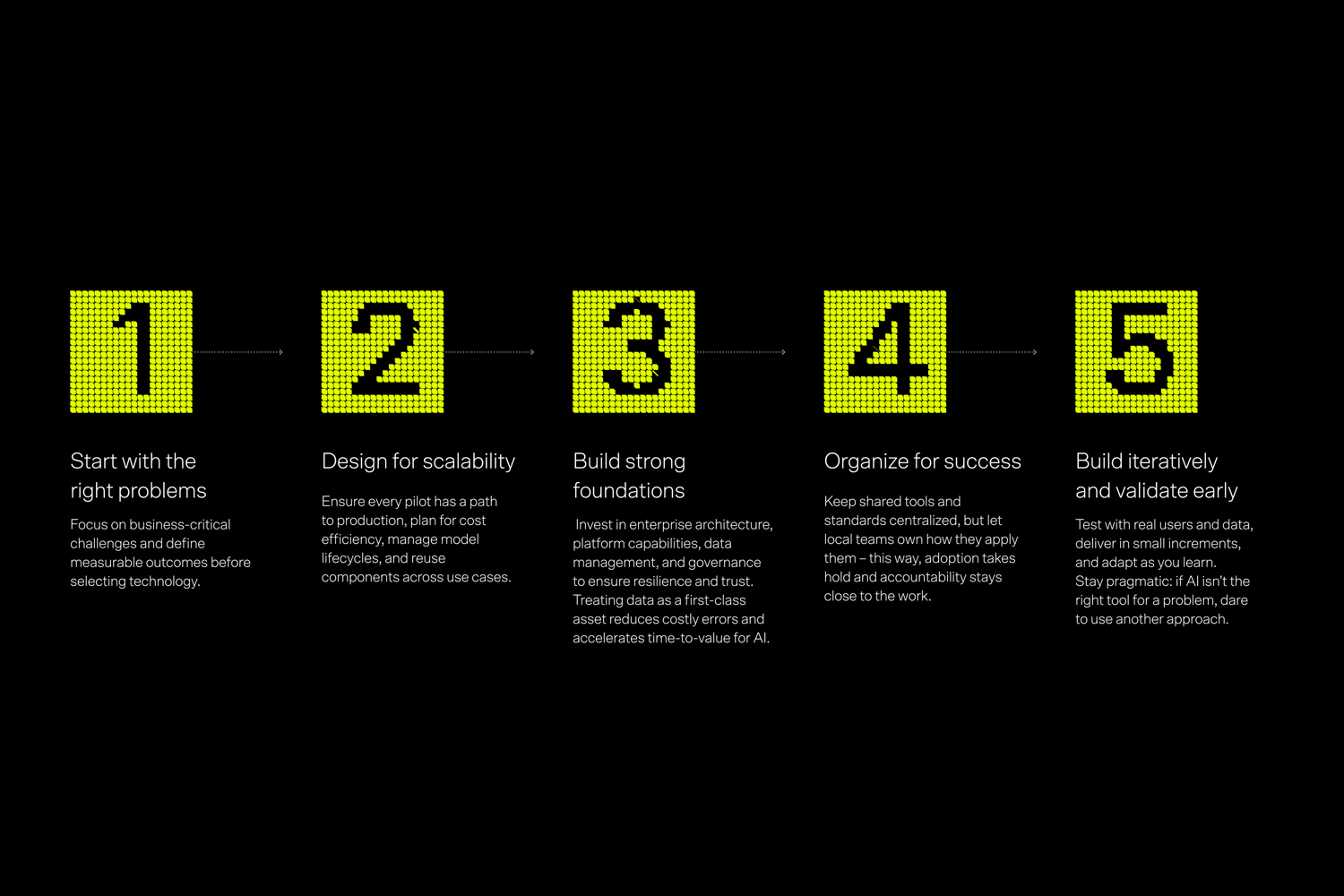
To turn ambition into action, we recommend the following steps:
- Start with the right problems. Focus on business-critical challenges and define measurable outcomes before selecting technology.
- Design for scalability. Ensure every pilot has a path to production, plan for cost efficiency, manage model lifecycles, and reuse components across use cases.
- Build strong foundations. Invest in enterprise architecture, platform capabilities, data management, and governance to ensure resilience and trust. Treating data as a first-class asset reduces costly errors and accelerates time-to-value for AI.
- Organize for success. Keep shared tools and standards centralized, but let local teams own how they apply them – this way, adoption takes hold and accountability stays close to the work.
- Build iteratively and validate early. Test with real users and data, deliver in small increments, and adapt as you learn. Stay pragmatic: if AI isn’t the right tool for a problem, dare to use another approach.
Not quite sure how to kick things off? Feel free to reach out – at Reaktor, we’re always ready to help.