

In an era where digital assistants plan our meals and curate our playlists, it was only a matter of time before they started shopping for us too. Agentic commerce marks a shift from search-driven consumption to autonomous decision-making. Most frequently, agentic commerce refers to AI-powered agents that autonomously search for products, make recommendations, and even complete purchases on behalf of consumers.
In this context, consumers can offload product discovery and transactions to computer agents acting as personal shoppers. Rather than manually browsing sites or entering search queries, a user might simply tell an AI, “Find me a green jacket to wear on stage during a presentation,” and let the agent handle everything from finding products to placing the order.
Major players are already moving on this: for example, Amazon’s new “Buy for Me” feature lets AI agents purchase products from third-party retailers’ websites on the user’s behalf, essentially robots transacting on retailers’ sites for human consumers.
Agentic commerce: how it works
Increasingly, shoppers are starting their product searches in conversational AI platforms like ChatGPT, Google’s Gemini, or Perplexity, rather than on search engines or retailer websites. These AI platforms are quickly becoming “a new kind of storefront” where discovery happens in natural language. PayPal predicts that within five years, 20-30% of its consumers will start their shopping journey through AI agents and tools instead of traditional websites.
OpenAI’s ChatGPT, for example, now offers an Instant Checkout feature that lets users buy products online in a chat conversation. In a recent pilot, ChatGPT users could ask for gift ideas and purchase an Etsy product without ever leaving the chat, with Stripe powering the payment behind the scenes.
This shift represents a fundamental change in how consumers can find and buy products online. Retailers will need to adapt their product data and infrastructure to stay visible in this new ecosystem.
AI agents don’t browse pretty pages or respond to marketing copy. They make decisions based on structured, machine-readable data delivered via APIs.
AI shopping agents don’t browse websites like a human; they ingest and reason over structured data. AI agents don’t browse pretty pages or respond to marketing copy. They make decisions based on structured, machine-readable data delivered via APIs. In other words, if a brand’s products and offers aren’t easily accessible to an AI agent in a structured form, that brand may as well be invisible.
Rather than scraping a retailer’s website (which is fragile and often inaccurate), advanced AI agents will query live data feeds for up-to-date product info like price, stock, and specs. New standards are emerging to facilitate this: Model Context Protocol (MCP) servers provide a live, structured data endpoint that lets LLM-based agents query product catalogs in real time. An agent connected to an MCP feed “isn’t scraping, it’s essentially subscribing” to a steady stream of clean product data (price, inventory, descriptions, metadata).
For retailers, this means optimizing product data for AI, ensuring product attributes, images, and descriptions are rich, structured, and machine-readable. It is becoming as important as SEO was in the past. Brands will want their catalogs readily accessible via these AI channels so that when a consumer’s agent asks, “Find me the best running shoes under $100,” their products are in the consideration set.
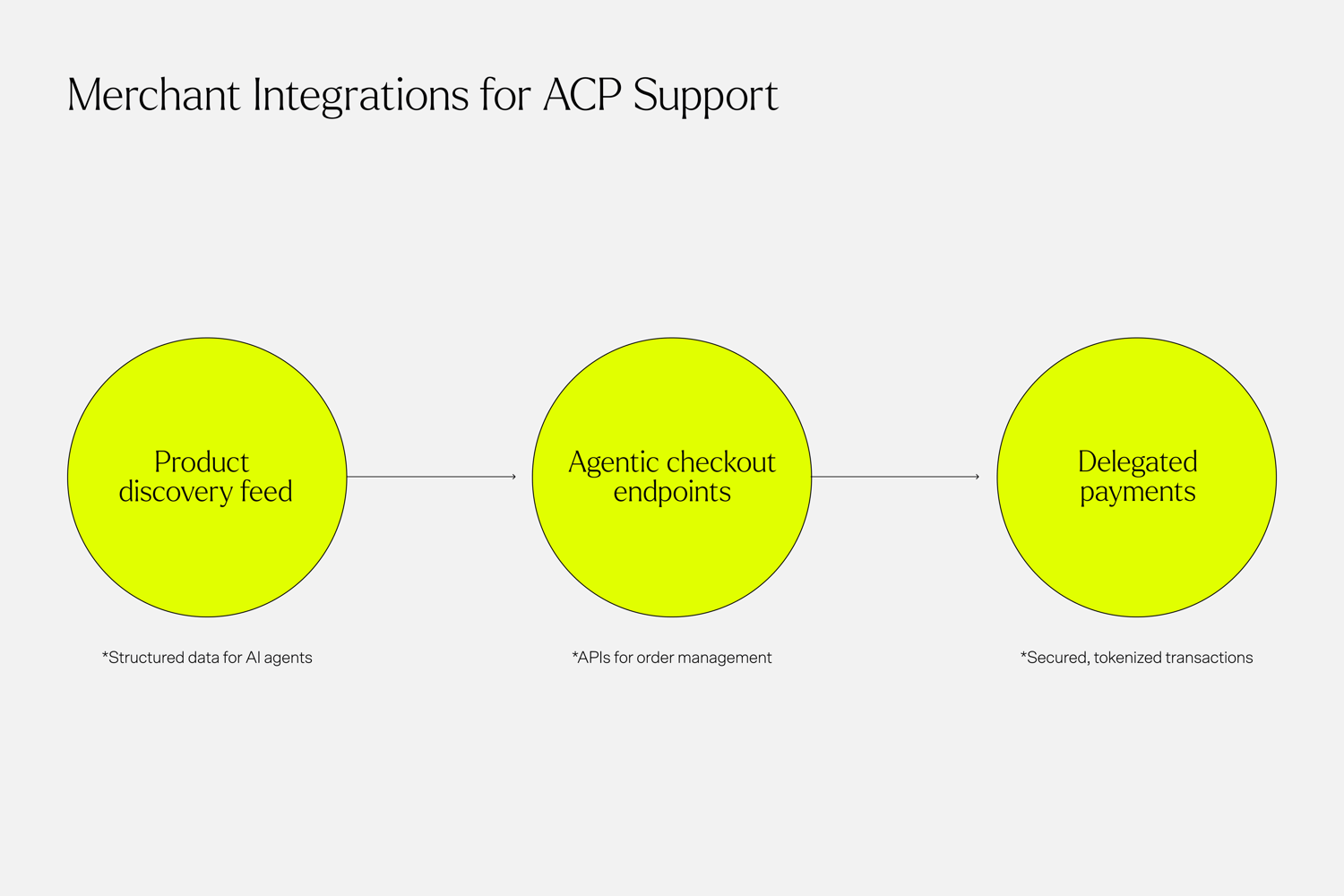
On the transactional side, retailers should prepare to receive orders from AI agents as a normal part of business. Instead of a human clicking “Buy,” an agent will submit the order via an API or protocol. This requires robust backend integration. It’s not practical for merchants to custom-integrate with every AI assistant, so tech companies are creating open standards to connect any agent to any retailer. The newly released Agentic Commerce Protocol (ACP) (co-developed by OpenAI and Stripe) is one such standard that creates a shared language between businesses and AI agents, enabling a single integration for merchants to handle orders from multiple AI platforms. In essence, retailers expose their products, pricing, and checkout processes in an AI-consumable way, and agents can carry out the purchase on behalf of consumers.
Importantly, this approach lets the retailers retain control over the transaction; they decide what’s available to the agent, how their brand and product info is presented, and they can accept or decline agent-placed orders as needed.
Now is the time to move
Because the retailers who move first will secure their presence in the next-generation shopping flow. Early adopters of agentic commerce are likely to gain a competitive advantage. If the product data is clean and accessible, AI agents will surface those products more often, driving sales without the need for paid ads. With MCPs, retailers don’t have to pay (yet) for visibility; they earn it by being accessible.
On the flip side, retailers that lag in opening up their catalogs risk losing out. Competitors who feed real-time data to ChatGPT, Google, or voice assistants will win visibility by default, as AI agents prefer sources they can easily query and trust.
We also want to highlight that in this emerging genAI engine optimization (GEO) field, brands and retailers don’t only need to ensure that AI agents can access and act on richer & more structured product data. Beyond product catalogs, some retailers are beginning to expose dynamic price negotiation APIs and loyalty program data in machine-readable form. This allows agents not only to consider and compare products but also to negotiate personalized deals or apply customer rewards seamlessly in real time.
In a world where agents might handle a large chunk of shopping, every retailer must ask: Will their products be discoverable and purchasable by AI agents? The answer depends on the actions they take now to integrate with this emerging ecosystem.
Risks and limitations
Shifting to agent-led commerce isn’t without challenges.
Fraud and security
If a bot can place orders, how do retailers ensure it’s legitimately acting on a consumer’s behalf and not a malicious script? This has led to innovations like user-controlled spending mandates and tokenized payments.
For example, Google proposed an industry-wide Agent Payments Protocol (AP2) that uses cryptographically signed mandates to authorize an AI agent’s purchases. Other leading global partners are also contributing to the protocol, like MasterCard, Revolut, PayPal, Adyen, American Express, and more.
How does it technically work?
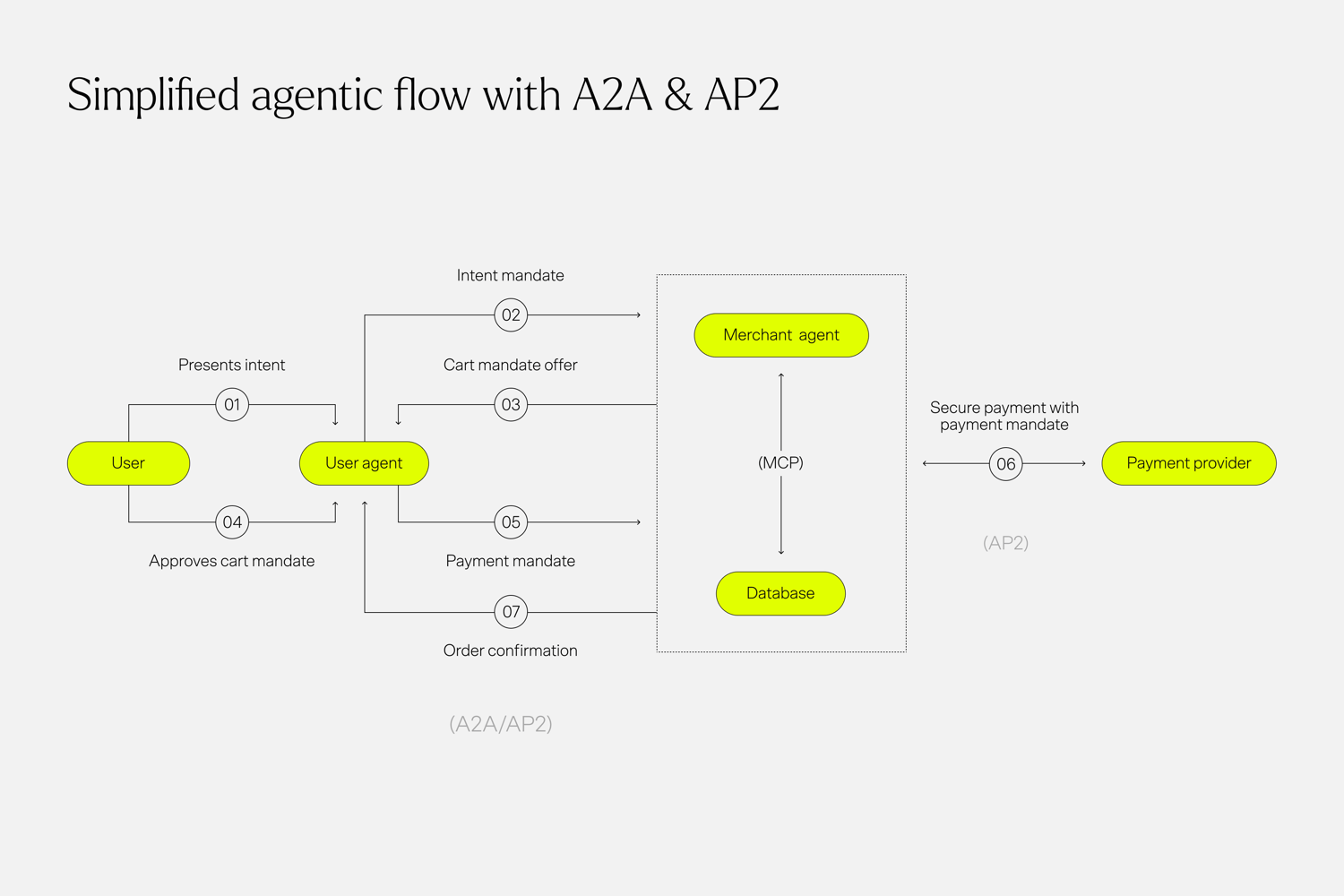
A consumer expresses what they want to buy, e.g., “Find and buy me two flight tickets to Miami under $300” and an intent mandate is created behind the scenes. That intent mandate is and will be an auditable context for the entire interaction. The conversational platform, e.g., ChatGPT, can ask some follow-up questions if the initial message and request is too vague.
Let’s take an example:
Consumer writes in ChatGPT: “Buy me comfortable running shoes under 100€, size US8”.
Here, no brand has been specified, so ChatGPT will follow up until getting the brand-related information e.g. “Do you have any brand in mind?” and after a few follow-up questions, the conversational agent might either choose one specific brand, if explicitly requested or expressed by the consumer, or might also autonomously pick any brand if the consumer expressed something along the lines of “I have no brand preference.” Brand is just an example; timeframe-to-buy, budget, and some other data points are must-have information in order for the intent mandate to be technically created under the hood.
Once the intent mandate is created, ChatGPT does its magic, choosing some eligible product(s) to recommend, and autonomously or semi-autonomously purchases the product(s). To do so, a cart mandate that lists the exact purchase the agent wants to make is created. Only with these signed mandates can the agent complete the transaction, so the merchant knows the purchase was explicitly approved by the user. If a consumer stated in the initial conversation, “buy it for me”, then there’s no confirmation needed, and the cart mandate is autonomously created.
Lastly, a secure execution mandate is created upon an agentic transaction, which is a proof of user authorization for the retailer’s e-commerce system to securely process the payment, mitigating fraud and ensuring trust.
In short, once a brand or retailer has done the necessary to make their products eligible for recommendations in those conversational platforms, new safeguards are being put in place to prevent unauthorized or rogue AI-driven purchases.
Liability and errors
If an AI agent makes a mistake, orders the wrong item or quantity, who is responsible? Retailers will need clear policies for agent-initiated orders, just as they do for customer errors or fraud. It’s likely that audit trails (via those mandates and tokens) will make it easier to trace what an agent was “told” to do by the user, which can help resolve disputes. Nonetheless, this is a new legal ground.
Technical and operational limitations
Many retail systems today treat non-human traffic as a nuisance; think of all the bots blocked by CAPTCHA on e-commerce sites. In an agentic commerce world, those “bots” may be legitimate consumers. Retailers will need to distinguish and accommodate good AI agents (the ones bringing orders) via dedicated APIs or endpoints, instead of throttling them. The cost of serving AI traffic may rise, too. If dozens of AI services are constantly querying a retailer’s inventory data, that’s a new load on the infrastructure. Solutions like separate AI data portals (e.g., api.yourbrand.com for agents) and rate-limited feeds will be important to manage this load.
With that being said, those challenges and limitations open up a lot of opportunities.
Opportunities for retailers
For forward-thinking retailers, agentic commerce represents a huge opportunity. It opens a new revenue channel consisting of highly intent-driven purchases.
To seize this opportunity, retailers need to take action. In practical terms, this means:
Enrich and expose product data
Audit product catalog for completeness and accuracy, and format it in line with emerging standards. This could involve adopting a Model Context Protocol feed or similar API so that AI platforms can query the latest products, prices, and stock levels effortlessly. Ensuring standardized attributes (sizes, colors, materials, etc.) and adding detailed, intent-oriented descriptions will make products more “agent-friendly” for discovery.
Evolve from headless commerce to faceless commerce for agentic transactions
Upgrade the e-commerce infrastructure to include APIs or integrations that handle agent-driven transactions. This is a new invisible storefront that is stripped away from design, human navigation, and UI decoration. Embracing open frameworks like the Agentic Commerce Protocol can save retailers from writing one-off integrations for each AI partner. By having a clear, documented interface for orders (with support for things like real-time inventory checks, pricing queries, and order placement), retailers make it easy for any approved AI agent to transact with their store.
Re-think security, fraud and and monitoring workflows
Work with payment providers to implement the latest in tokenized payments and agent mandates. This might involve new partnerships or modules in the payment stack, e.g., Stripe’s Shared Payment Tokens, or Visa’s Intelligent Commerce APIs to handle scenarios where the consumer’s agent, not the consumer directly, is initiating checkout. Update fraud prevention rules to account for agent-led orders. For instance, an agent might place multiple small orders in rapid succession at odd hours (perfectly legitimately), which legacy fraud systems might flag erroneously. On the monitoring and analytics side, understanding AI agent traffic, valuable AI agents, and distinguishing them from scraping bots becomes essential to effectively manage and leverage the increasing presence of AI in digital commerce.
Agentic commerce powering internal operations
Still, what often gets unnoticed among all the hype and noise is that agentic commerce isn’t only about consumer-facing shopping. Retailers are increasingly turning to AI agents to streamline internal operations – automating everything from inventory reorders and supply chain workflows, to personalized marketing campaigns and routine customer support.
Examples include Walmart, which developed an on-shelf availability computer vision system. The system has a series of cameras in their physical stores that detect low or missing stock items, and is being integrated into Walmart’s existing inventory systems. An automated alert system is also being set up to tell staff when items need replenishing. Similarly, adidas built a genAI agent workflow to analyze over 2 million customer product reviews, converting raw feedback into actionable insights for product, design, and marketing teams.
We see this as a leap forward in automation, one that goes beyond the machine learning applications of previous years. Since semi-autonomous or autonomous decisions can now be embedded within traditional workflows, they may already qualify as examples of agentic commerce.
Final thoughts
We’re moving into an era where AI agents don’t just shop, they collaborate. Soon, more complex requests like “Find a time when I, Lea, and James are free next week, book us a Padel court around Lea’s office, and send calendar invites. I’ll pay.” will unfold seamlessly through networks of interoperable agents.
As PayPal, Mastercard, and Amazon invest in the infrastructure and standards for agentic commerce, the future is already forming. Those who adapt early will define how consumers experience AI-driven retail, and Reaktor could and should play a leading role in that retail evolution.