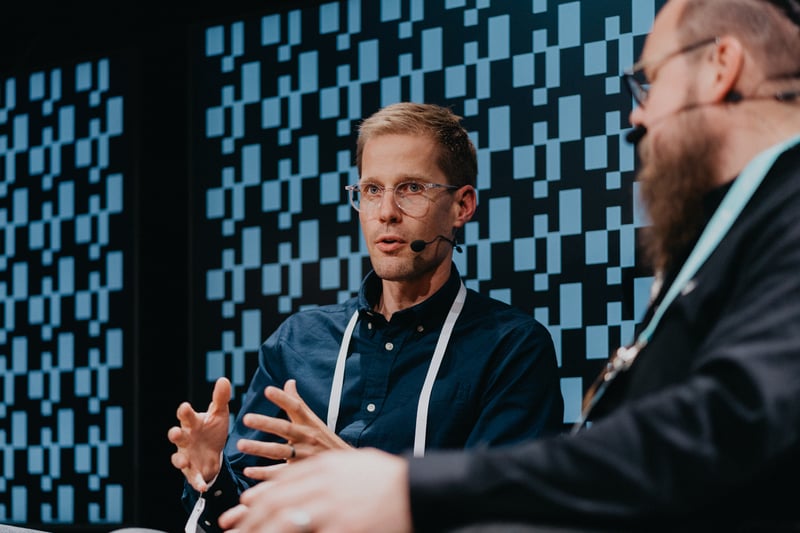
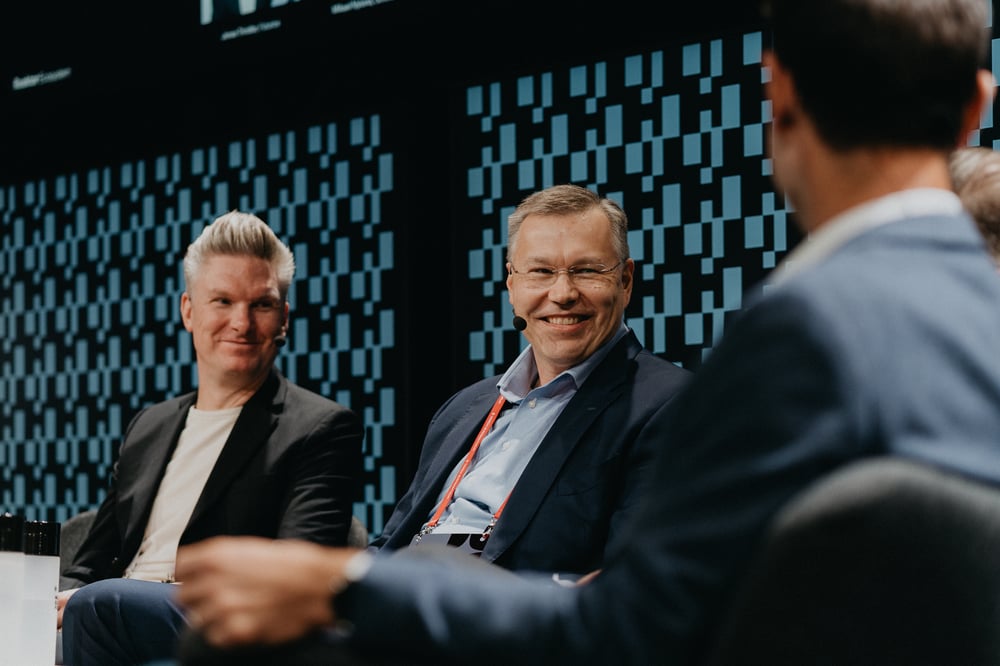
At the Nordic Business Forum in Helsinki, we brought together the CEOs of Finland’s four leading tech consultancies to share the same stage for an open discussion about the future of our industry. Pekka Horo (Reaktor), Ossi Lindroos (Solita), Jonas Trindler (Futurice), and Mikael Nylund (Gofore), moderated by Anni Erkko (Talouselämä), covered some hot topics of the moment. They discussed, for instance, the shift from employee-centric growth to being relentlessly customer-centric, the importance of fostering future talent, growing demand constraints, and AI, naturally. Watch the full session below!
It's not every day to have the four CEO's of Finland's leading tech consultancies share a stage for an honest conversation. In a highly competitive industry, these companies often find themselves in rival positions, bidding for the same talent or the same projects. As Jonas Trindler humorously put it, having all four CEOs on stage could look like a “street fight.” Yet, what the audience witnessed was a conversation full of alignment, shared concerns, and optimism for the future.
Here are the key learnings from the talk:
1. Rising competition calls for a relentlessly customer-centric mindset
The panel began with reflections on how the market has changed in recent years. In the past, demand for technology services consistently outstripped supply – there were always more customers seeking digital transformation than there were developers to serve them.
In the past couple of years, that balance has shifted. Companies have become more careful with their investments, pushing more work in-house, and forcing consultancies to rethink how they bring value. The cultural emphasis has shifted as well. Where companies once centered everything around building the best possible employee experience, today customer centricity has become paramount. Understanding customer needs, managing risks, and proving value quickly are now non-negotiables.
For consultancies has meant focusing much more on sales, especially solution selling, and developing a deeper understanding of customers’ businesses. In today’s environment, it is not enough to offer technical excellence alone – companies need partners who can connect technology directly to strategy, outcomes, and impact.
2. Growth demands international reach
The question of competition in the Finnish market naturally arose. Finland is a crowded space with increasing price pressure, where many players are competing in the same arena. The panel broadly agreed that the answer lies not only in sharpening value propositions at home, but also in cultivating a stronger international ambition.
Finland has world-class expertise, but companies must look beyond local markets and build global portfolios. Finland has historically excelled at exporting products, but it needs to strengthen its ability to export services. Pekka Horo highlighted how Reaktor has approached this challenge in its own way, not just through Reaktor’s own international growth but also through the Reaktor Ecosystem, a network of over 40 companies across 10 countries. For him, the question is not just how one company expands abroad, but how networks and collaborations can increase collective impact.
While the market is challenging, there are still interesting pockets for growth. Pekka Horo highlighted seeing growth in new domains, such as defense and security, and that blending consulting with product thinking offers entirely new opportunities.
3. Future talent and full teams are keys to sustainable growth
Talent and the future of work in technology were also key topics in the panel. Many wonder whether the industry remains attractive to employees, particularly younger generations entering a job market that has been more turbulent in recent years. The panel assured that there will still be software to write a hundred years from now, and that the industry remains broad and full of opportunities, not just for developers, but for designers, strategists, architects, and data experts. Yet, while the long-term future is bright, there is a responsibility to ensure that junior talent does not get left behind during difficult times, when they are often the first to be cut.
At Reaktor, our hope is that companies can do more to bring full teams (not just seniors) to client projects. For instance, our summer trainee program has been a way to give juniors meaningful project experience, even if it's a tougher moment for young professionals than just a few years ago. Still, the industry is, if anything, becoming even more interesting, as experts across every sector are increasingly able to shape the world through their work. Excitement lies in giving talented people autonomy and agency to tackle the biggest challenges of our time.
4. AI is a disruption and an opportunity
AI, unsurprisingly, was a recurring theme throughout the discussion. All four leaders agreed that it represents both disruption and opportunity. While it will inevitably reshape industries, jobs, and processes, it also offers new ways to drive productivity and innovation. Pekka Horo raised a particularly important point: that Finland’s education system should be preparing the next generation to lead in this evolution, not banning or downplaying the tools of the future. “How can we build a generation that’s the most skilled and equipped in the evolution of AI?”
The conversation closed with reflections on culture and ambition. Finnish modesty can sometimes hold companies back, and as leaders and even as parents, it is important to encourage people to take bolder steps abroad. Yet despite these challenges, all four CEOs were optimistic: the future of Finnish tech will be shaped by new tools, new markets, and an enduring ability to create value for customers.