

The conversation around value has felt particularly present within our clients, teams, and the broader digital product community (thank you budget cuts, tech layoffs, and the promise of AI productivity). Within the past year, we’ve noticed a difference in how our clients assess the value technical teams deliver, and how that influences the autonomy, effectiveness, and ultimately success of teams. Where digital is at the core of a client's business, product teams are viewed as revenue and innovation drivers, and core to the company’s success. For other organizations that don't see a close association between digital and their central revenue drivers, digital teams are often more at risk of being viewed as a cost to be managed: budgets are scrutinized even further, and most funding is approved for the “keeping the lights on” projects.
So, what’s a forward-thinking digital leader to do? While it can be easier to blame business leadership for not understanding the value of digital, we think it's more important to focus on what is within digital leadership and teams’ power to control. We asked leaders from disciplines across product, design, and engineering, and we received answers and ideas as varied as their roles. When we laid out all of the insights we gathered, a common thread seemed to be that the answer lies in shifting the way we think of ourselves - from feature delivery teams, to value creation teams.
We spend every day working with, thinking about, and delivering high-performing digital product development teams, so it's easy for us to jump straight to measuring our own effectiveness as a way to communicate. At Reaktor, we’ve been using DORA metrics for evaluating process performance and maturity, and the SPACE framework (Satisfaction & Well-being, Performance, Activity, Communication & Collaboration, Efficiency & Flow) to measure 5 dimensions of developer productivity at three different organizational levels - individual, team, and system. While these frameworks have been a major step in measuring what has traditionally been hard to measure, our experience is that they won't be the key to shifting business leadership's view of a digital org. If your projects are still viewed as a cost to be managed, then we’d simply be reporting on the efficiency of a cost. The most effective way we’ve seen our clients accomplish this shift is by moving their digital teams to a true product mindset and setting metrics and project goals that reflect that.
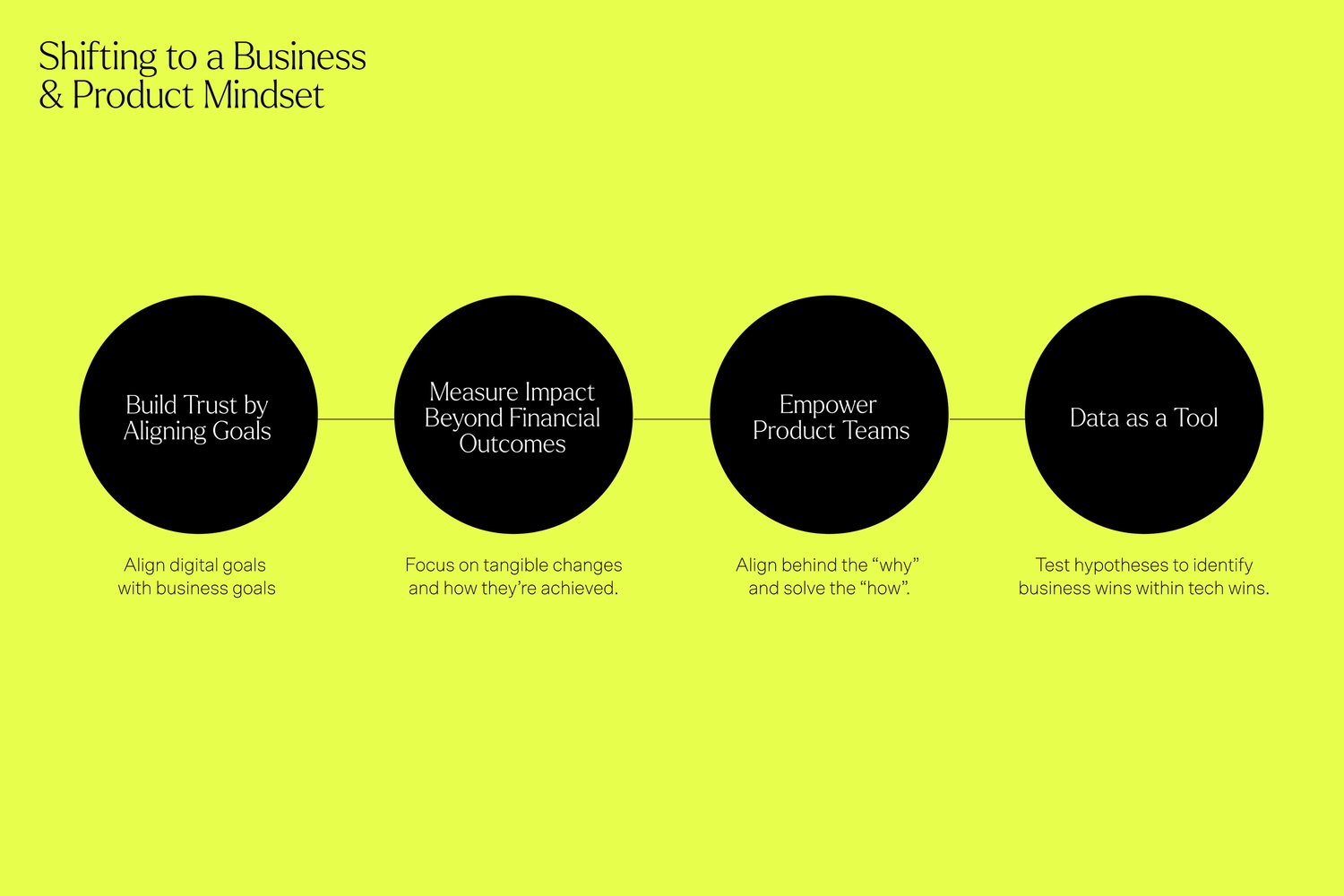
Adjusting metrics and goal setting, or possibly setting these sorts of targets for the first time, can sometimes make teams feel that there is a lack of trust. Truth be told, in our years of delivering digital projects, we’ve seen this sort of goal-setting as a side effect of low-trust environments. Whether you’re operating in a low-trust environment or not, part of a shift to a product mindset will be aligning digital goals with business goals, and this can do nothing but build trust between digital and the rest of the business. It’s important to note, that sometimes the cross-disciplinary conversations about goal setting and value creation can be just as valuable as the goals and metrics themselves.
Tying tech work to dollars is incredibly difficult. Instead, we recommend finding other measures of significance - what are the tangible things you’re trying to change and how do you change them? This could mean setting project goals like reducing the number of calls to customer service, increasing conversion rates, or reducing customer churn. These sorts of metrics are much easier for business leadership to understand the value of, rather than a more inward-looking metric like number of features delivered.
This also allows us to begin to align our product teams behind the right “why” of a project while giving them the freedom to solve the “how”, a critical piece of moving from a feature team to a true product team. Shifting from the feature factory to the product operating model will also allow teams to focus on outcomes rather than output, empowering them with a sense of purpose inspiring more innovation and effective problem-solving.
Another tool at your disposal is data. Specifically, using data as a way to test hypotheses to find business wins within tech wins. One of our retail clients found a great example of this. This client used their data to find that most customers would abandon the purchase process if a page load time exceeded 3 seconds. They also found that there was a direct correlation between reducing their load times and increasing conversion to purchase. Armed with this insight, they were able to communicate to business leadership that a team would be focusing on improving the performance of their site. Because of the groundwork they did, business leadership understood that this was a revenue-driving initiative, rather than a tech efficiency metric.
Marty Cagan, a respected thought leader for technology product management, tells us that “You can't take your old organization based on feature teams, roadmaps, and passive managers, then overlay a technique from a radically different culture and expect that will work or change anything.” We tend to agree; shifting to an empowered product operating model is much more complex than setting goals aligned with business value, but it's a good start. In today’s world, digital is at the core of every business, whether leadership sees it that way or not. It’s our job as digital leaders to lead the charge to champion the value we bring to a business’s bottom line.