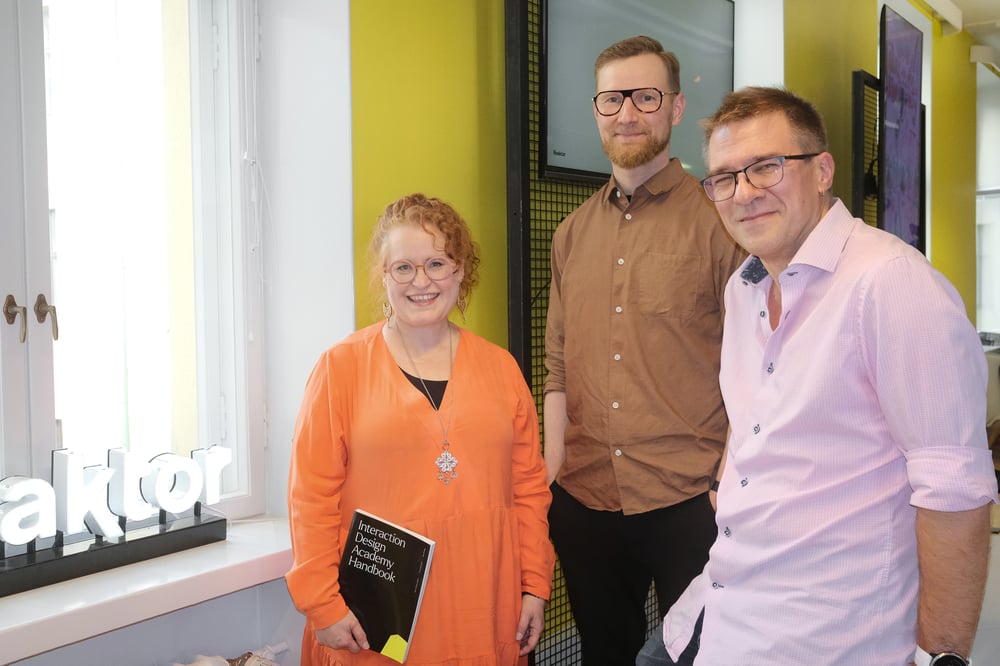
The just-released Interaction Design Academy (IDA) Handbook is nothing less than an attempt to ensure Finland’s competitiveness in digital design, say its writers, Karri-Pekka Laakso, Tiina Härkönen, and Kari Riihelä. They hope the book changes how design gets done, as the current state is often too detached from reality – to everyone’s detriment.
First of all, what is IDA Handbook and why is it needed?
Karri: It’s a practical book built around simulation-based design, helping designers at any level tackle challenges with confidence. It also forms the foundation of Reaktor’s internal training materials, which have been refined over more than a decade.
Kari: The handbook is about doing design in a more agile way, fully integrated into the entire product development process, as well as conducting user research so that it produces something tangible you can actually use while designing.
Tiina: Ultimately, it answers how to crack the hardest challenges that are in the way of the client’s business.
Is your approach new, or are there already books like this on the market?
Tiina: As far as we know, no. Anthony Ulwick’s Jobs-to-be-Done comes close. In both methods, the end-user’s goal and context are identified, and the focus is on understanding customer behavior and shifting perspective from what a product is to why it’s used.
Karri: Designing digital products the way we suggest isn’t rocket science – but doing it right is damn hard. Our book offers a clear and simple-to-follow framework and process that helps anyone succeed, no matter the field or type of digital design.
Kari: In the introduction of our book, we have this quote by Toni Morrison that goes, “If there's a book that you want to read, but it hasn't been written yet, then you must write it.” It’s fitting, as the existing books really didn’t really detail how to arrive at solutions after conducting research and user validation.
Going back to that simulation-based design, can you open it a bit and give a concrete example?
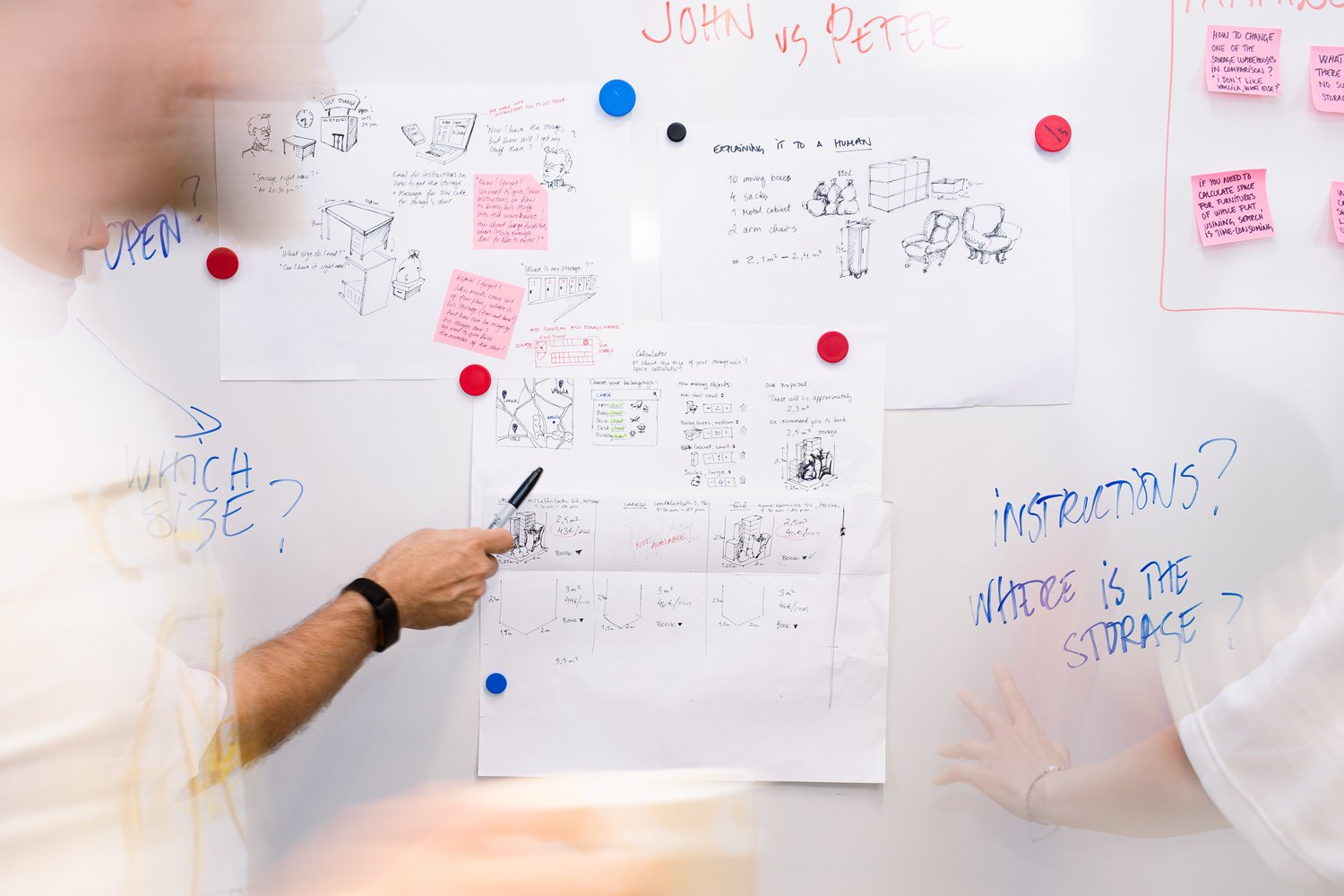
Tiina: The answer is in the name, really. Simulation-based design means creating by simulating each step of a specific situation – say, buying a train ticket or planning a holiday – and then mapping the necessary functions, interactions, and data to meet the user’s goal.
Karri: We dive so deep into the use case that we understand all the real data behind human actions. Then we build a systematic path: what the user needs to tell the system, and what kind of data the system needs to show the user so they can make a decision.
So this isn’t how design is usually done? What’s the difference?
Tiina: No, actually, far from it. Traditionally, you start with very broad user research, which takes forever. Then the results are interpreted, after which, somehow, “magically” a bunch of outcomes appear. Those are then tested with users. Often it’s only at this stage, very late into the project, that it becomes clear the solution may not serve the users.
Karri: A key aspect is that with simulation-based design, there won’t be huge logical gaps. When we build it step by step, it’s guaranteed to work in the situations we’ve planned for.
Tiina: Plus, it’s significantly faster and cheaper. And done right the first time.
Yet, you say that most of the time, a very different approach is taken. Why?
Tiina: When designing consumer products, many designers think they already know everything: “We get it, because we’re consumers too.” But that easily leads to designing for yourself – or for some imagined person in your head. That’s a huge trap.
Also, our method is bottom-up. Typically, designers start top-down, looking at the “big picture” first, and only later diving into the details and jobs on the ground. Doing the opposite, then, can feel uncomfortable to some.
Karri: Another thing is mental friction, as in, you have to arrange and schedule to meet with people in real life, observing how they do their job in their workplaces. That can feel socially awkward and way more hands-on than many designers are used to. But once you see how much you gain from it, it just clicks.
It’s taken years and hundreds of projects to get your thinking and routine to a point where you feel confident to publish it all in a book. Why do you want to give it all away after everything, and on top of that, as a freebie?
Karri: It’s a very Reaktorian thing to do, and definitely not the first time our people have shared their best-kept secrets. The basis for this book goes back years, to when we worked with the University of Helsinki, teaching simulation-based design in the Department of Computer Science. We built on those learnings over time. Ultimately, this is about receiving something and giving something back.
Tiina: And it’s in our interest too: the more people understand how to approach design, the more good products will emerge. That helps us grow as well. Our skills improve, our work gets better and easier.
We don’t think in terms of “how can we sell more?” Instead, if our clients succeed, we succeed. For us, it’s a matter of survival that our clients thrive. That’s how trust is built. By giving them the very best.
Related to sharing your work: In the book, you say that stepping up digital design isn’t just about craft, but actually a matter of ensuring Finland’s competitiveness. That’s a bold claim – especially now, when everyone’s saying AI and automation are the real drivers of advantage, not hands-on craftsmanship.
Karri: I honestly believe that even if just parts of our method were applied, the standard of app development would rise significantly. Considering the role IT and design play in our society, then yes, this could be our next national success story.
It won’t happen through AI, though, as AI can only give you averages of what already exists. It can’t create something truly new, unlike human approaches and methods.
Tiina: Technologies evolve quickly, but it’s only human-centered design that makes them useful. That’s why digital design expertise will be a critical skill in the future, not just for designers, but for everyone. This book aims to give people the mindset and tools to help build a more functional digital world.
Kari: There’s no denying that AI and new technologies make it easier and faster to create new services. With just a few prompts, basically anyone can spin up a working app or digital service. But our job as creators and humans is to make sure those apps are built to meet real needs.
Now that the long writing process is finally behind you, your handbook will soon land on the desks of designers in schools and workplaces alike. What do you hope its life will look like out in the world after release?
Karri: I would be extremely happy to see interaction design turn towards a more systematic approach instead of the current mentality, where many designers don’t seem to know whether their solutions are good or not. It would be really nice to have simulation-based design seen as common a tool as personas are in the toolbox of interaction designers. And it’d be great to see it taught again in universities and design schools, because, after all, the future of the field is in the hands of the young.
Kari: I’d love to see it spark conversations in classrooms, inspire workshops, and serve as a reference when someone feels stuck in their practice. In the best case, it could create a shared language and understanding that helps designers, developers, and product owners alike build better digital products together.
Tiina: My boldest dream? That this method becomes Finland’s next big export. Not just another design method, but a real mindset shift: the ability to create solutions rooted in real human needs and goals, solutions that spark real happiness.
And I see this going even beyond that, to reshaping processes, organizations, and society itself. Imagine a future where design thinking from Finland helps people create a better world that people actually love.
IDA Handbook
Get your copy of the IDA Handbook
Download the Interaction Design Academy handbook for free.
Download the book