
The emergence of Generative AI changes how we design and develop services. GenAI will improve the efficiency of the design and development, but more importantly, it will open up completely new and potentially disruptive opportunities.
The three lenses of innovation
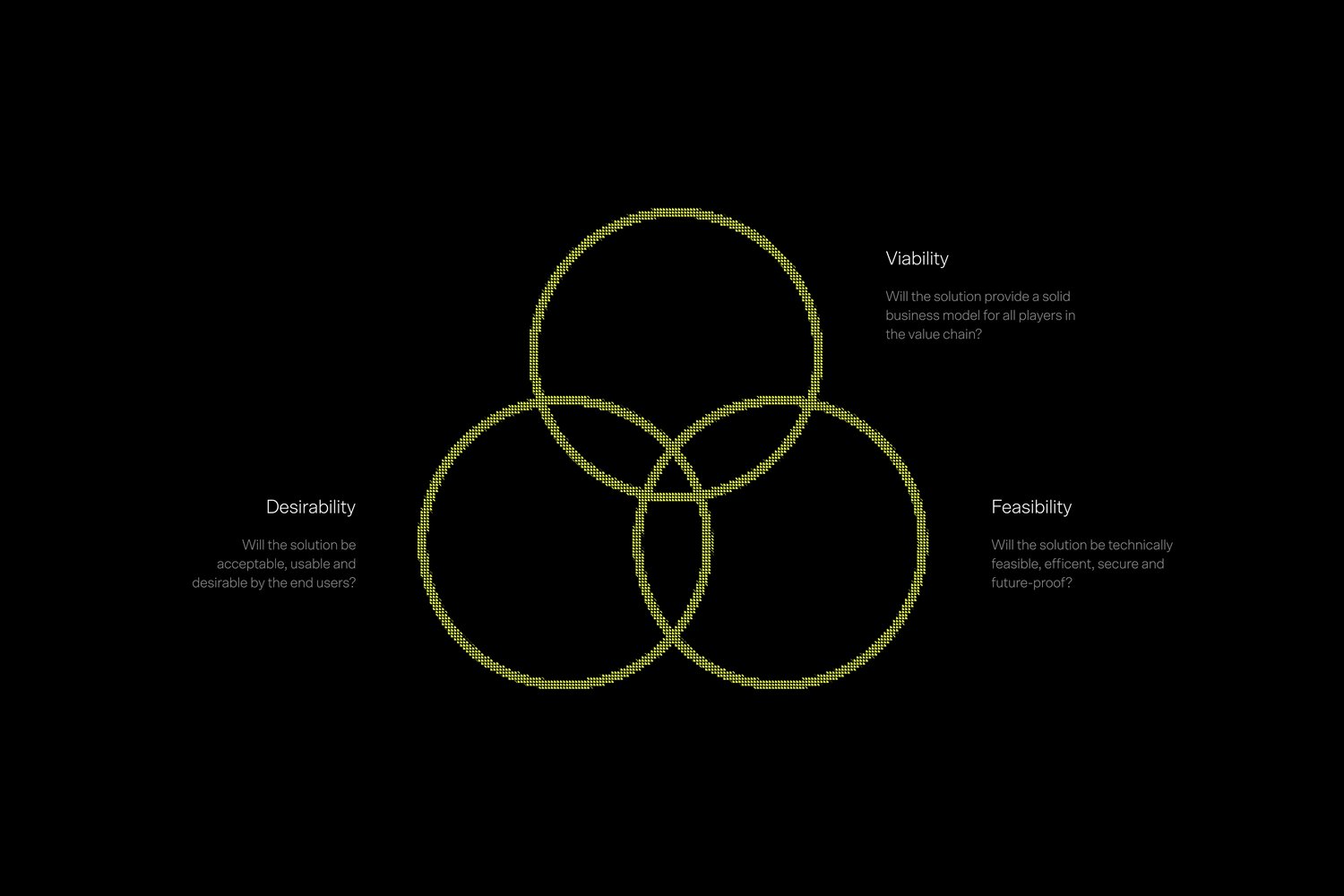
Successful services are at the intersection of the three lenses of innovation [1]: they are desirable to the users, they are technically feasible, and they provide a viable business model. Finding that sweet spot is not easy; we recommend the user-centred approach, where the primary goal is to ensure that we can provide such compelling benefits for the end-users that they are willing to pay a price for the service that we have a strong basis for a successful business case.
New revenue opportunities with Generative AI
Generative AI impacts the development of digital products and services in two ways:
- Productivity increases with the use of AI-enhanced design and development tools, such as Copilot, Midjourney, ChatGPT, etc. (internal benefits)
- New revenue opportunities enabled by Generative AI (external benefits)
While the productivity increase can be significant (estimates range from 3% to 60 %), the real disruptive potential lies in integrating GenAI into products and services that companies offer for their clients. This is simultaneously an opportunity and a threat that people in every boardroom should consider.

Designing the value propositions
Designers are the best allies for product management when planning for the value proposition for the product or service: what unique value does the product bring to the client and other stakeholders in the value chain? This forms the income side of the business model equation. To complement this, product management needs to consider the technical feasibility, the investment and operating costs of providing and operating the service (including the new GenAI API costs).
The search for the sweet spot in the intersection of the three lenses of innovation is best done iteratively. Early drafts of the value proposition and the designs can be evaluated with the clients and end-users. For this, product management and design typically work together to create mock-ups and prototypes of increasing fidelity. With each validation round, the confidence in the value proposition increases and the product design is solidified.
Designing for GenAI
Designers face two new challenges when designing services that utilise Generative AI.
First, designers must understand very well the opportunities that GenAI offers. This requires a good understanding of the basics of how different GenAI models work, what they are good for, and especially what are the pitfalls, so that they can contribute to the design and planning of the value proposition. Research suggests that having carefully prepared inspirational material in design workshops helps to alleviate this challenge [2].
Secondly, the indeterministic nature of GenAI means that designers must learn new patterns for the detailed user interface design, such as supporting rich textual input, recovering from inaccuracies in the output of the large language modes (LLMs), informing users about the nature of GenAI, and handling the varying response times of the models. To support this, new style guides and design heuristics are emerging in the industry and academia [3].
Implications to the innovation and design process
The currently prevalent model of designing digital services has relied on prototyping with tools like Figma to create mock-up layouts and clickable prototypes of the proposed service. These have been used to elicit feedback from the end-users, customers, and other stakeholder groups. Current prototyping tools produce a pre-programmed response; it is difficult to simulate the responses of LLMs or image generation with the current tools. Therefore, GenAI requires new approaches and new tools to support the design process.
Our recommendations are:
- Pay extra attention to the user needs analysis; after all, GenAI is still a means to accomplish the users’ goals.
- Pair a product designer with a GenAI expert to work together in tight symbiosis
- Create the first mock-ups as static screens or traditional clickable prototypes (e.g. in Figma), but provide several scenarios with different inputs and GenAI outputs. Verify with the GenAI expert that the prototype outputs are realistic and verified.
- As soon as reasonable, move to functional prototypes and early implementations, with a focus on the GenAI (the rest of the UI can be static scaffolding)
- Evolve the functional prototype into a proof-of-concept (PoC) that can handle a wide range of user inputs, for validating the value proposition with a variety of realistic use cases
- Continue the iteration towards a minimum viable product (MVP) for validation on the field
Creating successful products and services that utilise GenAI is genuinely a team effort. If you until now were able to plan, design, and develop products and services in separate silos, with Generative AI this will not be possible anymore.
There are no shortcuts to the future
Understanding the full potential of Generative AI is not easy. We are in the early phases of the GenAI era. With the first proof-of-concepts and released services, we are getting a glimpse of what the future will bring us. We assume that only after the introduction of these first-generation GenAI services, will we genuinely start to understand the full potential of the new technology. There are no shortcuts in this learning process. The only way is to start; and if you want to be the one that is disrupting and not the one being disrupted, it’s best to start today.
References:
- [1] Design Thinking Defined, IDEO
- [2] Creating Design Resources to Scaffold the Ideation of AI Concepts, Nur Yildirim et al, HCI Institute, Carnegie Mellon University
- [3] Design Principles for Generative AI Applications, Justin D. Weisz et al, IBM Research
DATA, AI & LLM SOLUTIONS
How Reaktor can help you with AI
From generative AI to data strategy and custom models, we help you build transformative AI solutions with value-first approach.
Discover our AI offering