

Imagine having a difficult problem to solve, and you have organized for everyone to meet at the office, and five minutes before the meeting starts, you get three requests for a meeting link? Similarly, when you have spent hours preparing online collaboration tools, four out of eight participants join the collaboration through a single phone on speaker? The results of either of these meetings tend to be mediocre at best.
Over the last couple of years, I have tried to understand “remote work” and its broader implications; what to potentially consider as individuals, groups, and organizations. I have seen many happy with their on-site, hybrid, or remote-first setup. To them, I say: If it’s working for you, your team, your organization, and your clients, savor it and keep going!
For some, the Monday morning spark is gone, work feels like work, teammates and clients are unhappy, results are dwindling, and the root cause is hard to pinpoint. Imagine this rut, like the bottom of a pit where people either bitterly commute to the office and sit through meetings with headphones on or remotely present newly discovered ideas while one participant is visibly talking to their kid and the other is on mute with the camera off. Talk about feeling unheard and unappreciated.
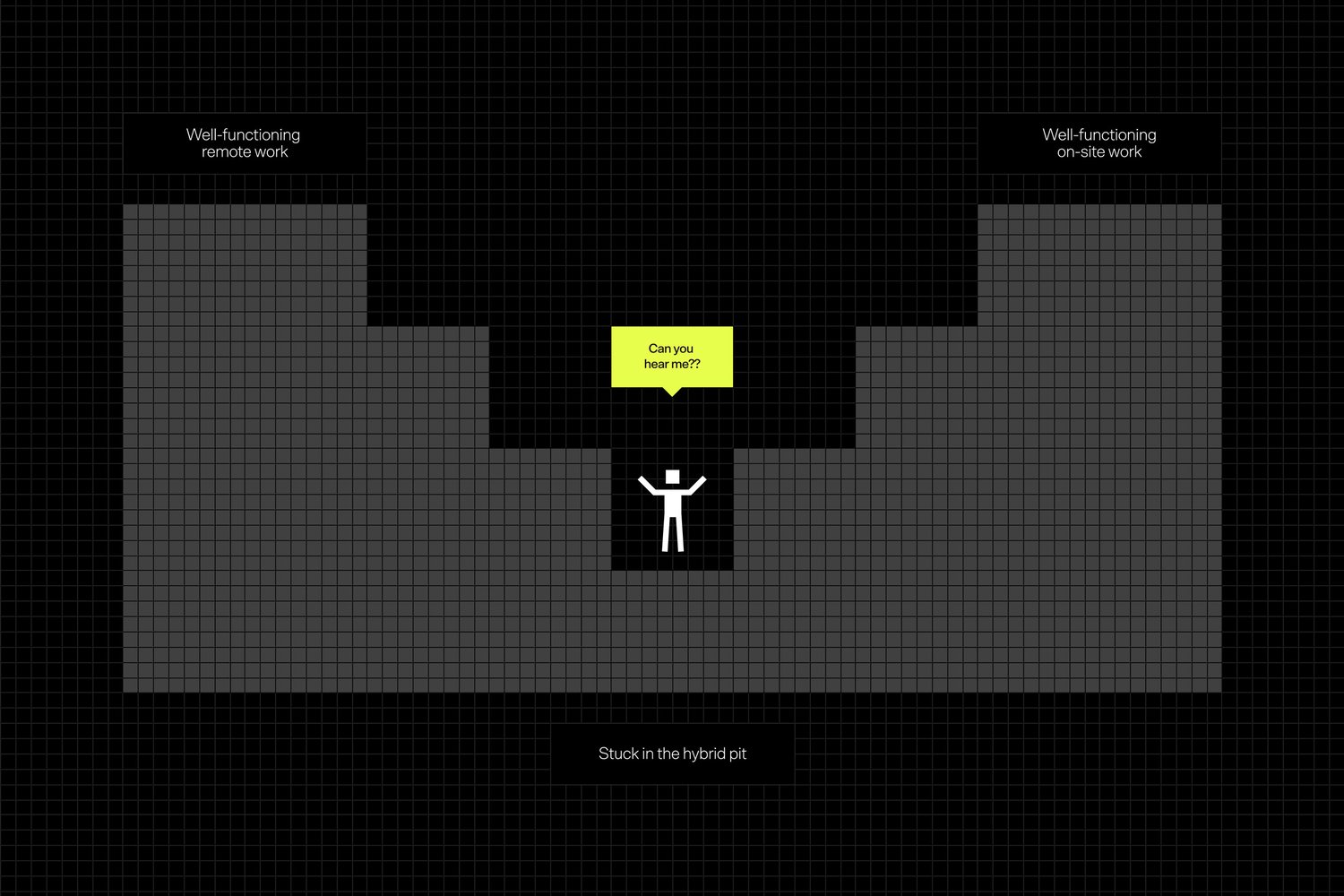
I’ll let you in on a secret. The issue is not about the amount of time spent at the office as such but about quality and alignment. It seems that the happiest people are those who have made their choice to pursue either primarily on-site or remote work – and their employer supports and shares this choice.
Now imagine a world where your company and you share the vision of how to work. All involved are passionately experimenting and eagerly sharing what they’ve learned with the ultimate pursuit of finding what truly works. A place where you’re equipped with tools that help you excel. Sounds like paradise, right? That’s what climbing out of the pit can feel like.
A little glossary
On-site/hybrid = Substantial time spent together at the office. At least two days a week together with your colleagues.
Remote work = The daily work is organized online, even for months at a time. Meeting in person happens regularly throughout the year.
Stuck in the hybrid pit = Poorly organized on-site or remote work without meaningful face-to-face encounters.
Climbing out of the pit: what’s holding us back
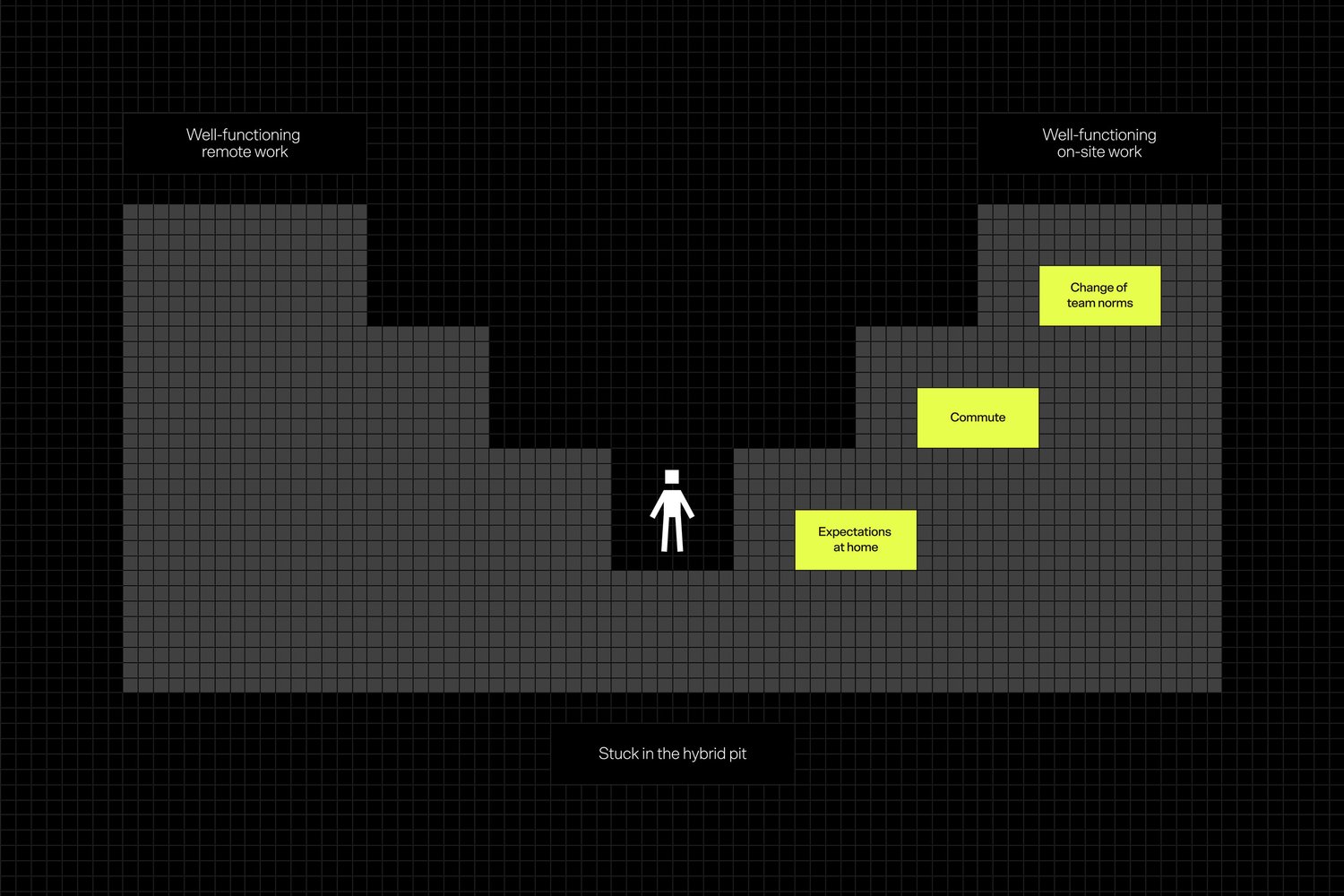
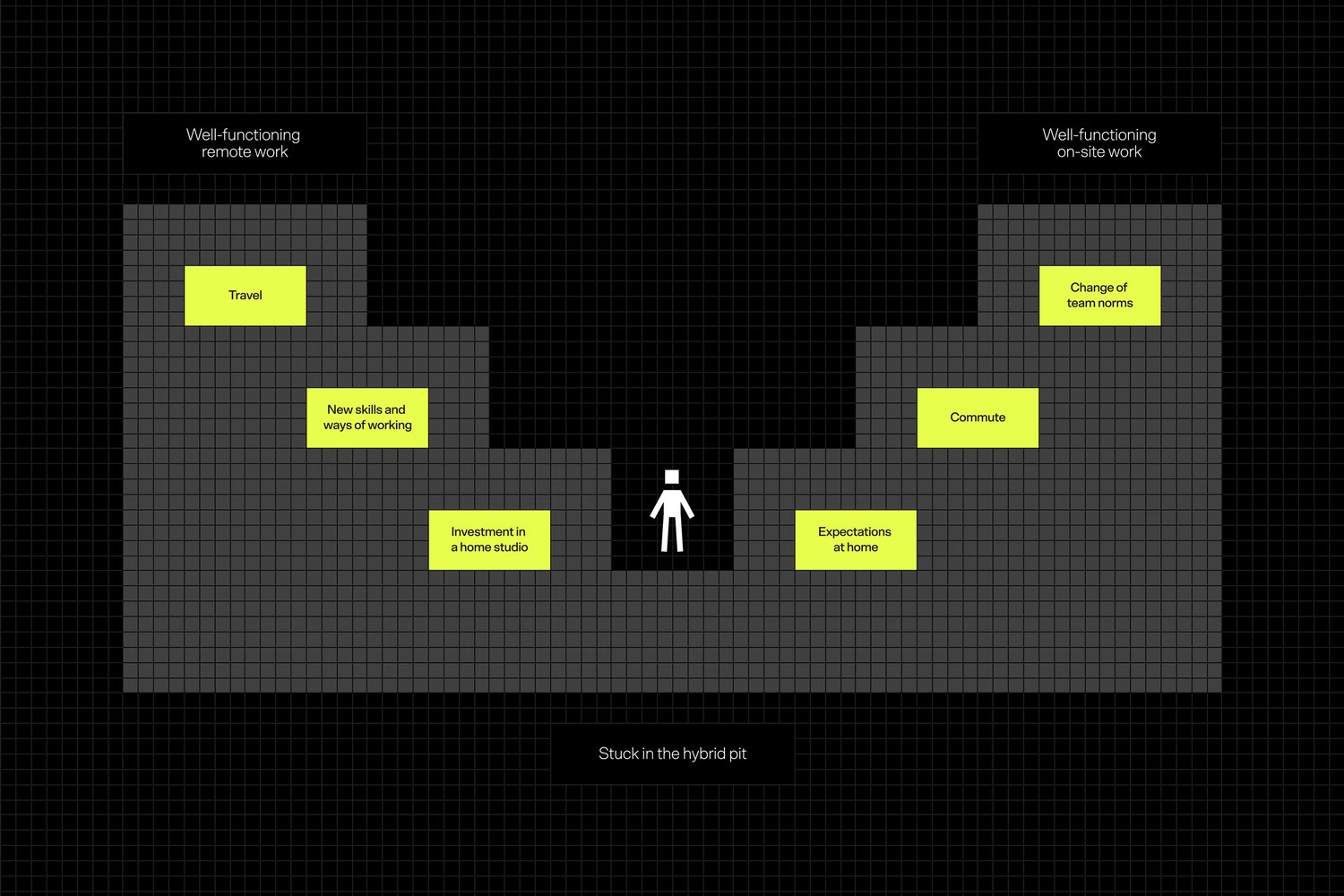
Imagine yourself at the bottom of this metaphorical pit, working mostly from home with the occasional office day or the reverse. To your left lies seamless remote work; to your right, smooth, well-functioning on-site work. Both options feel out of reach and are blocked by a multitude of barriers.
Barriers blocking smooth on-site work
Let’s explore the barriers blocking great on-site work where creative ideas flow, conflicts can be growth opportunities, and colleagues spend quality time together.
- Expectations at home: These might be expectations set by a spouse, children, parents, or a family pet. Working from home enables being there when the kids arrive, having dinner on the table by 6 pm, or it might allow having a small child at home or caring for an elderly parent. Family life has been built around this daily presence. Rearranging it could be costly in time, effort, and/or money. The status quo would be disrupted which allows for the family to currently function.
- The commute: One, two, or even four hours of daily commute feels like a horrible monster one doesn’t want to deal with ever again. Sitting in endless traffic, a congested subway, or enduring the icy wind on a bike. It is never-ending, time one cannot get back. Plus, this monster costs money!
- Unsuitable office space: Once you finally get to the office, the flow often gets interrupted. The space might be noisy, there’s no place to visualize work, or the right people are nowhere to be found. Worst of all, there might not be a hot desk available if you arrive any later than 7 am.
- New norms within the team: How to make sure the others actually show up? Many companies have made an explicit decision of “two days a week together” but turn a blind eye when the rules are ignored. A real hurdle is having a difficult discussion about new norms in the team and holding each other accountable. How will people react? These kinds of conversations require admitting being unhappy with the way things are currently organized.
- Personal barriers: There can be many other personal barriers, such as hitting the gym outside of peak hours, taking the dog out, driving the kids to hobbies, and so forth.
Barriers blocking functioning remote work
We can see or at least read about individuals, teams, and organizations that are excelling in a remote-first reality, strict regimes, effective meetings, and meaningful communication. What makes it so difficult to go all in?
Well-functioning remote work is invisible to most. The concept is elusive, and the barriers blocking us are often unknown.
- Investment in proper remote studio equipment at home or nearby: A crisp voice, clear picture, quiet environment void of distractions, low-latency connections, and large screens are complete essentials. That might mean bargaining with the family about converting the extra bedroom or kid’s playroom into an at-home studio or secluding a part of a room from noise and disruptions. Another possibility is to rent an office close by so cooperation at work is as seamless as possible. This requires time, effort, and perhaps a monetary investment.
- New skills regarding methods and tools: Well-functioning remote work might mean changing habits like multitasking through meetings, doing laundry, or reading emails. It might also mean learning virtual best practices such as online facilitation, visualizing work online, and finding the best ways to document work for someone else to pick up asynchronously. Remote workers need to be creative about bonding with colleagues when all breaks tend to be spent individually. Mastering online work can be uncomfortable and difficult, and it most definitely requires commitment and effort.
- Identifying as a “remote worker” in the job market: A few years ago, the big tech giants in Silicon Valley handed out pay cuts to those who worked entirely remotely. This is because it’s either seen as a benefit or the pay is pegged to the living costs of a specific region. Are you ready to be part of a potentially cheaper remote workforce?
- Traveling to meet colleagues and clients: Remote work might mean trading a daily commute to traveling longer distances to meet with the team or clients. This is a big commitment with all the potential jetlag, waiting at airports, and negotiating with the family about absences. A colleague of mine said that the best way to intensify the get-togethers is to meet in neutral places where everyone explores together and there are no routine engagements to get back to at home.
The vicious cycle of declining teamwork
At the bottom of the pit, barriers on both sides loom over and cast shadows. People end up swearing over the long commute, crappy office coffee, sitting alone in meeting rooms, or similarly raving about having to join meetings at odd hours, not understanding poorly written documentation, or having to endure distractions from five different environments.
This tends to dampen team spirit. Conflicts grow among teams and require more effort to solve every passing day. When conflicts among colleagues grow, there is usually less reason to get together, less incentive to try new things that may enable better communication, and eventually, people prefer to just take the next ticket or task and work on it alone. The results decline. The vicious cycle of declining teamwork is complete. The cycle affects both individuals’ and teams’ well-being and, ultimately, the results teams produce – regardless of whether you are at the office or remotely.
Commit (At least for now)
When the conscious primary choice is made, you can start the climb out of the hybrid work pit.
A conscious choice does not mean you only work remotely or on-site. It means you have decided to invest in one over the other and have accepted the costs of overcoming the barriers of that choice.
Once the costs are accepted, we can start to make the most of them, whether that means embracing the commute by reading or making the most out of a flexible remote set-up. The choice propels us forward, invites constant development, and gives us direction.
Join the most suitable environment
Alignment is key to making us feel like part of a bigger purpose with a shared goal. If you know what you want, have accepted the barrier cost, and made a commitment, and you still feel like you’re treading water, you might ask yourself: “Is the company I work for aligned with my choice?”
If your choice is on-site, frustration may arise when the office space is given up. The once well-working space for the team has been downsized to hot desks for only 30% of the people. Frustration may arise as teammates suddenly join meetings from a noisy pool in Jamaica, or the leadership is forcing the use of new online tools that require additional effort to master. Annoyance could reach new heights when the pressure to schedule meetings at odd hours starts to trickle in as colleagues calling in from India and Atlanta are expected to be on the same call. Not to mention, the growing need for documentation as work is often picked up through an online tool.
It might not feel great when the company suggests traveling every other month and pressures employees to sort out a proper at-home studio, even if the company would cover the expense. Why not just meet at the office like we did in the past? Why not visualize the work on a physical whiteboard, eat lunch together, and go home at a reasonable hour?
When the company gets rid of the expensive office and invests in remote gear and company trips, should it be viewed as forcing employees? Or as a strategic choice?
If you choose to pursue remote work but your organization is on-site first, you might not be getting the support you need. There might be no budget for the team to travel, get top-notch equipment, or master the best ways of working. Moreover, a primarily on-site organization might not focus on creating the same rights and possibilities to contribute regardless of the timezone or geographical location. Similarly, remote employees can have fewer opportunities to feel part of the community. Employees might feel like they’re left out of important decision-making because they’re not roaming the hallways of the office.
When the company decides to pull employees back to the office five days a week, are they forcing us? Or just making their clear strategic choice?
Conclusion: Utopia or the fruits of conscious choice and alignment
Most of us spend a substantial part of our day at work with our colleagues. Do you want to spend it at the bottom of the hybrid pit? Or will you take on the climb toward better Monday mornings?
The happiest employees aren't necessarily the most comfortable, the best paid, or the ones who tick off the most domestic chores during the workday. The happiest might just be the people who have made their choice, share that choice with their employer and team, and start each week focused on the work at hand together with their colleagues – instead of pouring that focus into the next rant about them and their deranged choices.
Work should feel like a second home, where you are accepted as you are, goals are shared, and teammates pull in the same direction, regardless of whether you are sitting across from each other or thousands of miles apart.