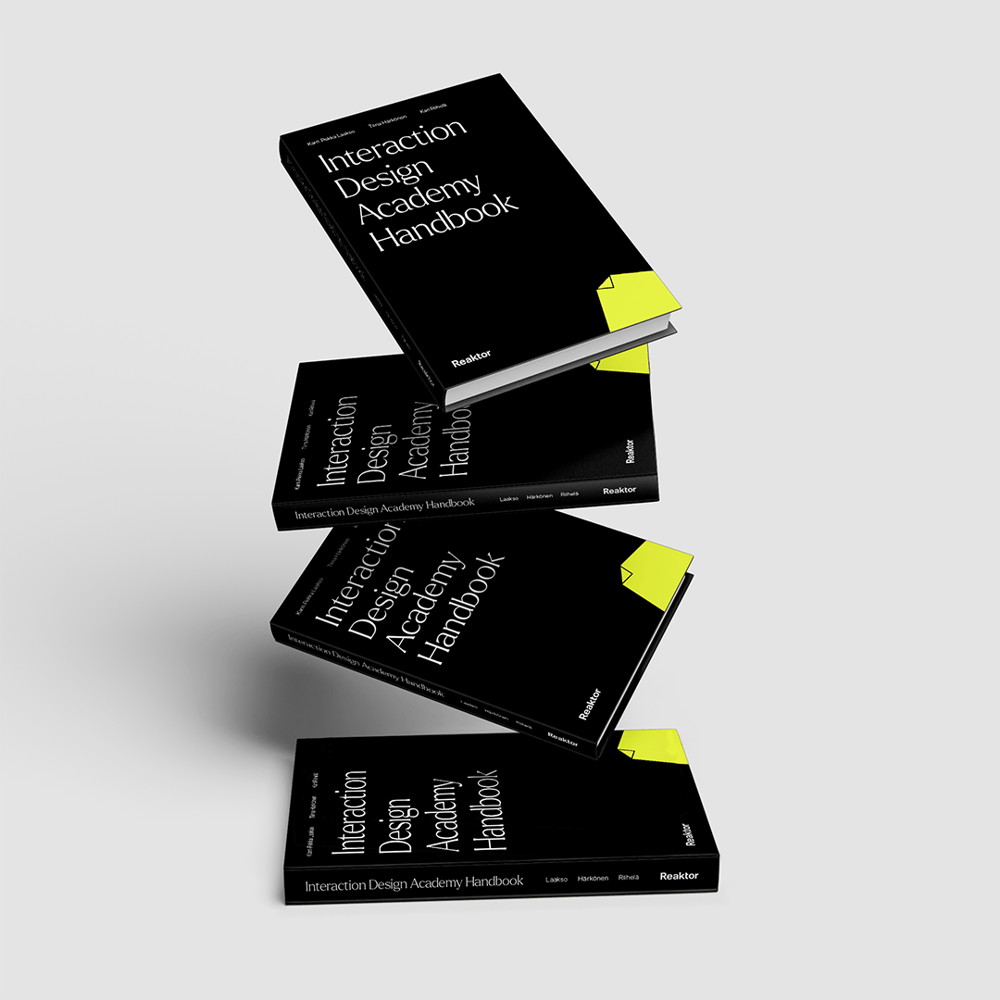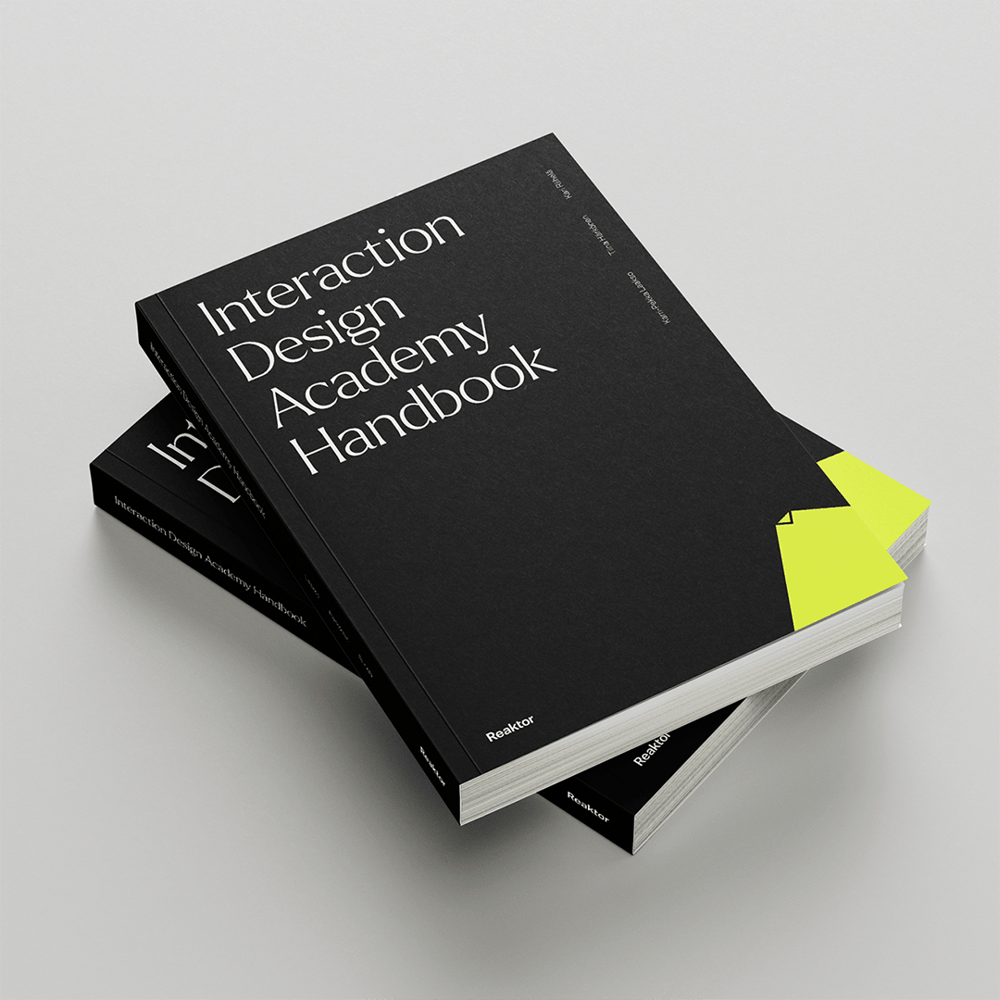
Practical guide to efficient and smooth interaction design
How can you design UIs that are both efficient and user-centered?
What level of research is actually necessary?
Do you need a complete software specification before coding begins?
The Interaction Design Academy Handbook gives practical, actionable answers to these questions – and more! Written by seasoned designers at Reaktor, this handbook is your go-to resource for confidently tackling design challenges. Every method and insight shared has been tested in practice and proven to be useful in real-world applications.
This book forms the foundation of Reaktor's internal training materials, refined over a decade of use. If you've been searching for a systematic approach to user interface design, look no further. The simulation-based design method introduced here has been successfully applied to hundreds of customer projects across all industries Reaktor has worked on, enabling the creation of powerful, enjoyable digital tools. It has also helped countless designers overcome creative roadblocks when traditional approaches fell short.
Whether you're just starting out or looking to improve your design skills, this handbook is made by designers for a designer just like you.

Who is it for?
Reaktor's Interaction Design Academy (IDA) began as an effort to teach interaction design to our colleagues. At some point, we began to combine all the course materials into one document. That was the beginning of this handbook.
Beyond just Reaktorians, we wanted to share our insights and enable designers all around to access this material. That's why we've made it free for everyone to download – and are happy to donate physical copies to schools, universities and other organizations.
The Interaction Design Academy Handbook is not just meant to be read once. It can be revisited and referenced whenever you need help in your design process. Our dream is to see these books on the desks of designers – even better, if they are so used that you need to Scotch tape them.
You can access the ebook by submitting the form below. And if you want a physical copy of the handbook, let us know in the form below, and we'll do our best to get one for you or your organization!

What's in the handbook
Research
Uncover the typical cases where the users would benefit from the help of the software we are building. Once we know those cases, we can design support for them.
Cases
Cases are the bridge between research and design, the means to transfer the knowledge gathered in research into a design that supports the users' needs. In this part, we describe the anatomy of a case and compare it to other similar constructs.
Creating Design
Creating the design is the engine of interaction design work that all other parts serve. Research gives guidance on what to solve. Evaluation gives direction on where to improve. But if an actual design isn't created, all those other actions are purposeless.
Design tools
Design tools are techniques and tools deeply tied to creating designs. In the beginning, paper prototyping is the fastest way to present ideas in a tangible format that others can understand. Interaction design patterns and principles guide solutions toward a more effective and powerful ones and offer tools for analyzing existing solutions.
Evaluation
To improve your design, it needs evaluation. The ultimate validation comes from real users doing their tasks with the released software or service.
Practice
Design is just a plan for what could be done. It has limited value in isolation. To produce value, design needs to be implemented somehow.
IDA HANDBOOK
Get your copy of the handbook
Get your copy of the e-book or contact us for a physical copy
Download